

Why decorate a door when you can create a scene? The most memorable Halloween houses don’t just hang a wreath — they transform the entire entrance into a little world. Your front door becomes a stage, the porch becomes the set, and every visitor becomes part of the story.
A spooky scene works because it engages the imagination. Instead of seeing decorations, people see a narrative: something happened here. The door is boarded, the spiders have taken over, the witch is home. That storytelling instinct is what makes a scene unforgettable long after the candy is gone.
In this guide, you’ll learn how to turn your front door into a spooky Halloween scene: choosing your story, building the scene in layers from door to kerb, and adding the interactive touches that make visitors feel part of the haunting.

Choose Your Spooky Story

Every great scene tells a story. Before you buy or build anything, decide what happened at your front door. Was it boarded up to keep something in — or out? Did the spiders claim it years ago? Is it the entrance to a witch’s cottage, a vampire’s manor, a mad scientist’s lab?
Your story determines every choice that follows. A boarded-up door needs planks, chains, and warning signs. A spider’s nest needs webs on every surface and egg sacs in the corners. A witch’s cottage needs a crooked sign, potion bottles, and a broom. When every element serves the story, the scene feels real.
Scene stories that captivate:
● The abandoned house: boarded door, chains, dust sheets, “condemned” signs.
● The spider’s nest: webs everywhere, giant spider, wrapped “prey” bundles.
● The witch’s cottage: crooked everything, cauldron, potion bottles, broom.
● The graveyard gate: tombstones, skeletal hands, dead flowers, iron fencing.
The best scenes have a backstory, even if you never tell it. Knowing what happened at your door — even privately — guides a thousand small decisions: how the boards are nailed, where the webs are thickest, what the sign says. Visitors won’t know the story, but they’ll feel it.
Build From the Door Outward

Start at the door — it’s your focal point — and work outward toward the street. The door gets the hero treatment: the main decoration, the most detail, the best lighting. The porch and steps get supporting elements. The walkway and yard get hints that draw people in.
This inside-out approach creates depth. Visitors encounter the scene in stages: a glimpse from the street, more detail on the walkway, the full reveal at the door. Each stage should add something new, building anticipation like the acts of a play.
Layering the scene:
● Zone 1 (the door): hero decoration, wreath or door cover, best lighting.
● Zone 2 (porch/steps): supporting characters — skeletons, pumpkins, lanterns.
● Zone 3 (walkway): guiding elements — luminaries, tombstones, footprints.
● Zone 4 (street view): the teaser — something tall or glowing visible from afar.
Don’t neglect the ground. Visitors look down as they walk, and the walkway is your opening act. Scattered leaves, faint footprints, a trail of luminaries — these guide the eye and the feet toward your door while building anticipation with every step.
Add Motion and Surprise
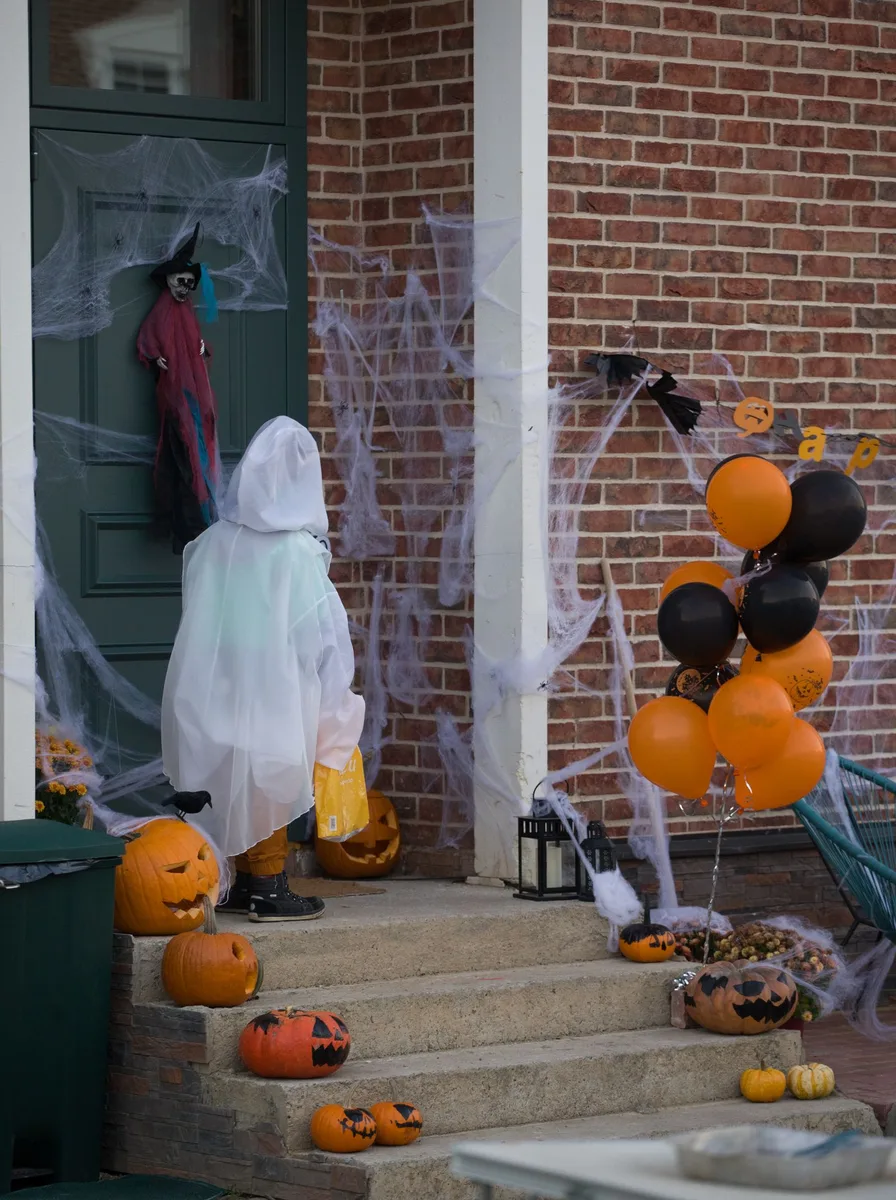
Static scenes are decorations. Scenes with motion are experiences. Anything that moves — even slightly — catches the eye and raises the heart rate. Hanging ghosts that sway in the breeze, a rocking chair that rocks on its own, curtains that billow from an upstairs window.
Motion-activated decorations are the heavy hitters: a skeleton that lunges, a witch that cackles, a ghost that drops from above when someone approaches. Place one good scare along the natural path visitors take, and your house becomes legend.
Motion and surprise ideas:
● Hang lightweight ghosts and bats where the breeze catches them.
● A motion-activated prop near the doorbell for a perfectly timed scare.
● A rocking chair with a hidden motor — or just a well-placed breeze.
● Projected shadows or lights that flicker as if something moved inside.
The most effective motion is subtle. A ghost that sways gently is eerier than one that flails wildly. A curtain that moves when there’s no wind. A rocking chair that shouldn’t be rocking. Subtle motion suggests presence; wild motion suggests mechanics.
Light the Scene Like a Movie Set

Lighting makes or breaks a spooky scene. Harsh white porch light flattens everything and kills the mood. What you want is theatrical lighting: uplights that cast long shadows, coloured lights that tint the scene, and deep darkness in the corners where imagination fills in the blanks.
Think like a lighting designer. Uplight your scariest elements from below — monsters always look scarier lit from underneath. Use coloured spotlights (green, purple, red) aimed at the house facade. Keep the walkway dimly lit for safety but shadowy enough for suspense. And use fog if you can — light beams cutting through fog are pure cinema.
Scene lighting techniques:
● Uplight key decorations from below for dramatic, monstrous shadows.
● Wash the house facade in green or purple with outdoor spotlights.
● Keep corners dark — what visitors can’t see is scarier than what they can.
● Add fog and let the light beams do the storytelling.
Rehearse your scene the way a theatre company rehearses a play. Walk the full path from street to door at night, with all effects running. Note every moment that falls flat and fix it. A spooky scene is a performance, and performances need rehearsals.

David is the home decor enthusiast behind HomeLushly. He shares practical, budget-friendly ideas for bedrooms, living rooms and seasonal decorating — from colour combinations that actually work to small-space styling tricks that make a room feel bigger. Every guide on HomeLushly is built around real photos and hands-on research, to help you make your home feel warm, personal and beautifully put together.