

Designers make elegant dining rooms look effortless, but there’s a method behind it. Elegance on walls comes from symmetry, restraint, quality materials, and perfect proportions — the same principles whether the budget is £200 or £20,000. Once you know the rules, you can apply them yourself.
This guide reveals the designer playbook for dining room walls: how to plan like a pro, use moulding and panelling for architecture, choose art with confidence, light it all beautifully, and finish with the details that separate designed rooms from decorated ones.
None of these techniques require professional skills — just patience and attention to detail. Elegance, it turns out, is mostly about doing simple things precisely.

Plan With Symmetry First
Symmetry is the fastest route to elegance. Designers start wall plans from the centre outward: a sideboard centred on the wall, art centred above it, sconces equidistant on each side. The human eye reads symmetry as calm and expensive, even before noticing any individual piece. It’s the reason hotel dining rooms feel instantly restful — everything is where your brain expects it to be.
Designing symmetrically:
● Find the centre line of each wall and build outward from it — mark it lightly in pencil.
● Pairs beat singles: two sconces, two matching artworks, two topiaries on the sideboard.
● Keep the table centred under the pendant and the pendant centred on the room — alignment matters.
● If perfect symmetry feels stiff, use “balanced asymmetry”: different objects of similar visual weight on each side.

Add Architectural Moulding
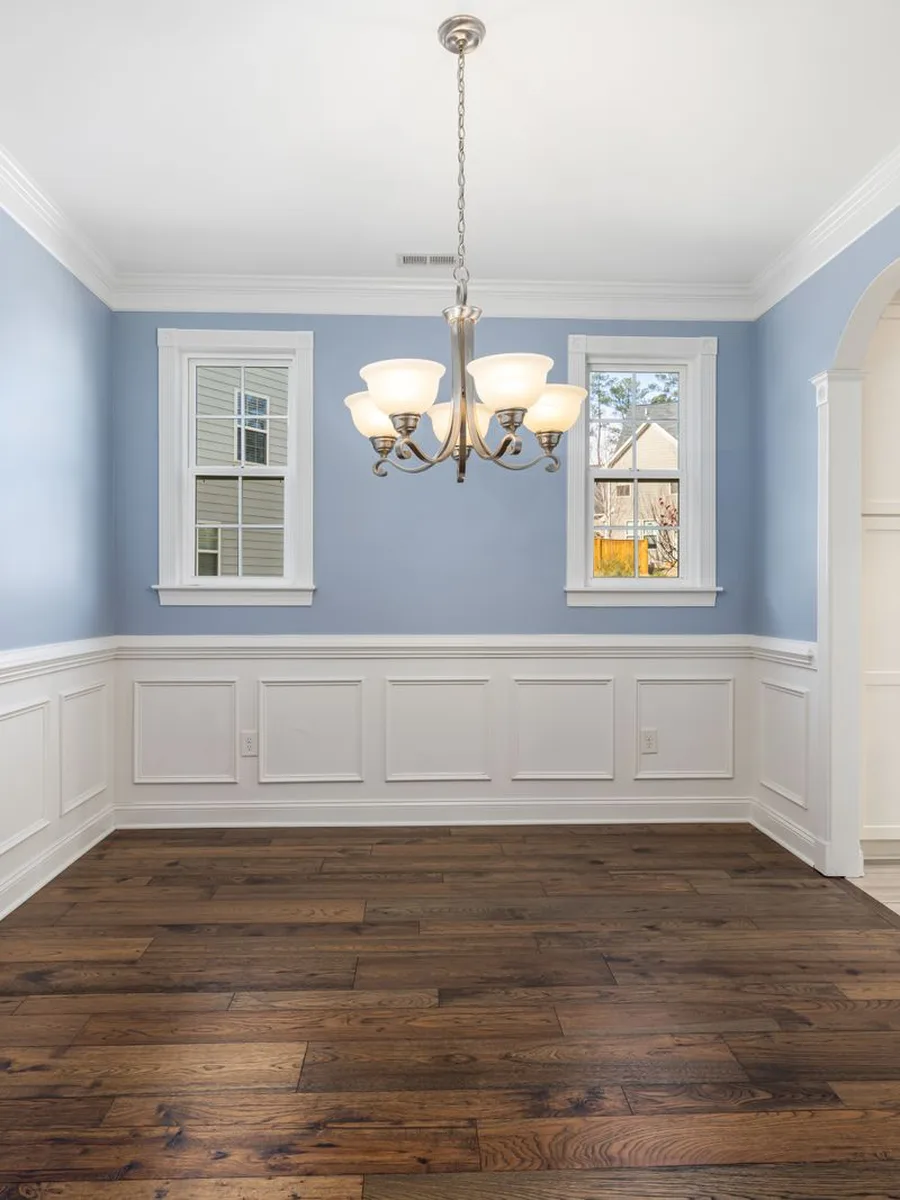
Wall moulding — picture-frame panels, chair rails, or full wainscoting — is the designer’s secret weapon for instant elegance. It gives flat plaster walls the architecture of a period home, and painted the same colour as the wall it looks refined rather than fussy. MDF strips and adhesive make it a genuinely DIY-able weekend project.
Moulding done right:
● Picture-frame moulding (rectangles of trim on the wall) suits dining rooms perfectly — formal but not heavy.
● Paint moulding and wall the same colour in a durable eggshell; contrast looks busy, tone-on-tone looks rich.
● Size the rectangles to the wall: taller panels on tall walls, and keep margins even all round.
● Finish with caulked joints and sanded edges — crisp lines are the whole point.
● In low-ceilinged rooms, run the moulding higher than the traditional chair-rail height to stretch the walls visually.
● For renters, lightweight foam moulding with adhesive strips gives the look with zero damage.
Curate Art Like a Collector
Designers don’t “match” art to the sofa — they choose pieces with presence and hang them with conviction. For an elegant dining room, choose art that’s calm and confident: landscapes, abstracts in muted tones, or classic black-and-white photography. One strong piece beats three timid ones.
Art rules designers follow:
● Go bigger than feels safe — undersized art is the most common elegance-killer.
● Invest in proper framing: a wide mount and a quality frame elevate even affordable prints.
● Hang art so its centre sits around 145cm from the floor, aligned with seated eye level.
● Leave it alone once hung — constantly rearranging reads as indecision, not style.

Layer Lighting for Atmosphere
Elegant dining rooms glow. Designers layer at least three light sources: a statement pendant over the table, wall sconces for ambient wash, and a picture light or candles for sparkle. Each on a dimmer. The result flatters the room, the art, and the guests — which is the real point of a dining room.
The lighting layer cake:
● A pendant or chandelier hung 75–90cm above the tabletop anchors the room.
● Sconces flanking a mirror or artwork add the symmetrical glow designers love.
● Picture lights turn art into jewellery after dark — brass finishes suit elegant rooms best.
● Candles on the table are non-negotiable for evening elegance; use unscented so they don’t fight the food.
● Keep spare bulbs in the same warm tone — one mismatched cool bulb in a sconce pair ruins the symmetry.

Style Surfaces With Restraint
The sideboard against your beautiful wall deserves styling, not storage overflow. Designers use the rule of three and varying heights: something tall (branches, a lamp), something medium (a stack of art books, a vase), something low (a bowl, candles). Then they stop. Negative space is a luxury material.
Styling the designer way:
● Vary heights across the surface — flat, same-height rows look like a shop display.
● Include one organic element (stems, a plant) to soften all the straight lines.
● Corral small items on a tray so they read as one intentional grouping.
● Leave a third of the surface empty — the breathing room is what makes the rest look curated.
● Step back and squint: if the silhouette looks balanced as a blur, the styling is right.
Obsess Over the Details
What truly separates designer rooms is invisible to most guests: straight picture hangs, hidden cables, matching hardware, fresh paint edges. Elegance is precision. Walk your dining room with a critical eye and fix the small things — they cost nothing and change everything.
The designer’s final walk-through:
● Level every frame and mirror; even a slight tilt breaks the spell.
● Hide or tidy every cable — trunking painted the wall colour disappears completely.
● Match metals: if sconces are brass, the picture light and curtain hardware should be too.
● Touch up paint scuffs and chips; worn edges are the fastest elegance-killer of all.