


Your dining room walls are doing nothing — and they could be doing so much. Most people spend time choosing the right table, the right chairs, the right lighting. But the walls? They get a single piece of artwork hung too high, or worse, they stay completely bare.
That’s a missed opportunity. Your walls are the largest canvas in the room. They set the mood before anyone sits down. They tell guests something about who you are. And the best part? You don’t need a designer or a big budget to make them work.
Whether your style is farmhouse cozy, modern minimal, or bold and eclectic — there’s a wall treatment here that fits. These 25 ideas cover everything from gallery walls to textured panels, vintage mirrors to DIY macramé. Each one is designed to be approachable, affordable, and genuinely beautiful.
Read on. Your dining room is about to become everyone’s favorite room in the house.
1. Build a Gallery Wall with Thrifted Frames
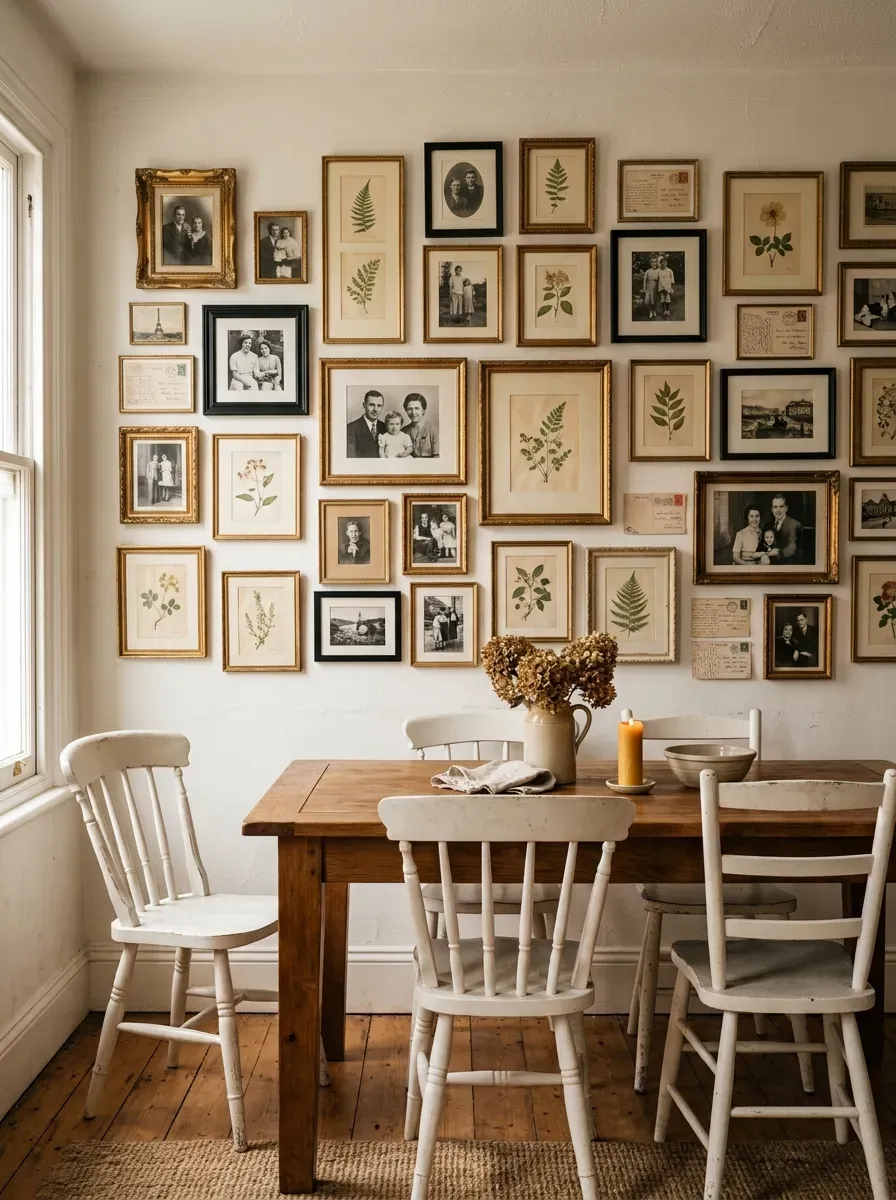
A gallery wall is one of the most personal things you can hang in a dining room. And it doesn’t need to be expensive.
Start by hitting your local thrift stores. Look for frames in different sizes — don’t worry about matching them perfectly. Mismatched frames actually look more curated and lived-in than perfectly identical ones.
Mix the content. Try combining family photos with simple line drawings, vintage botanical prints, and a favorite quote written by hand. The variety is what makes it interesting.
Before you hammer a single nail, lay your frames out on the floor. Arrange them until the shape feels balanced. Take a photo with your phone so you can reference it while hanging.
A simple trick: trace each frame on kraft paper, cut out the shapes, and tape them to the wall with painter’s tape. This lets you see the final arrangement before making any holes.
For a cohesive look without spending much, print black-and-white photos at a local pharmacy — they’re usually under $1 each. Slip them into thrifted frames with a simple white mat and you have a polished gallery wall for under $30.
Budget tip: IKEA’s RIBBA frames are inexpensive and come in neutral tones that work with almost any style.
2. Hang a Large-Scale Botanical Print
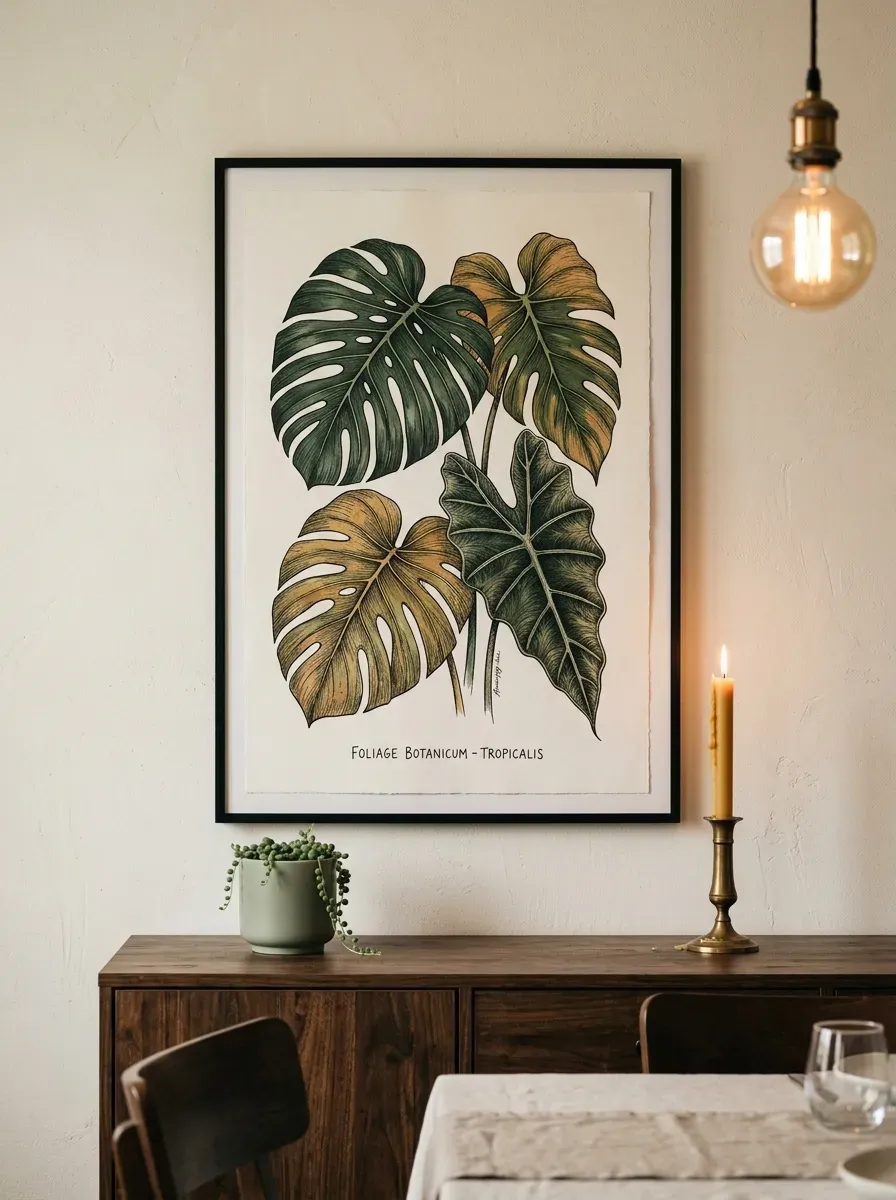
One bold print can do more for a dining room wall than five small ones.
Large-scale botanical art has a timeless quality. It works in farmhouse settings, modern spaces, and everything in between. The key is going big — a print that’s at least 24×36 inches makes a real statement.
You don’t need to buy an expensive original. Printable art is one of the best-kept secrets in home decorating. Sites like Etsy sell high-resolution digital files for $5 to $15. You download the file and take it to a local print shop or an online printer like Printful or Canva Print.
A 24×36 print at a local shop typically costs $15–$25. Add a simple black or wood frame from IKEA, and you’ve created a stunning focal point for under $50.
Choose a print with colors that pull from your dining room palette. If your chairs are dusty blue, look for a print with blue-green tones. If your table is warm walnut, go for ochre and terra cotta botanicals.
Hang it at eye level — roughly 57 to 60 inches from the floor to the center of the art. Most people hang art too high. Dropping it lower makes the room feel more intimate and grounded.
3. Create a Macramé Wall Hanging with DIY Knots
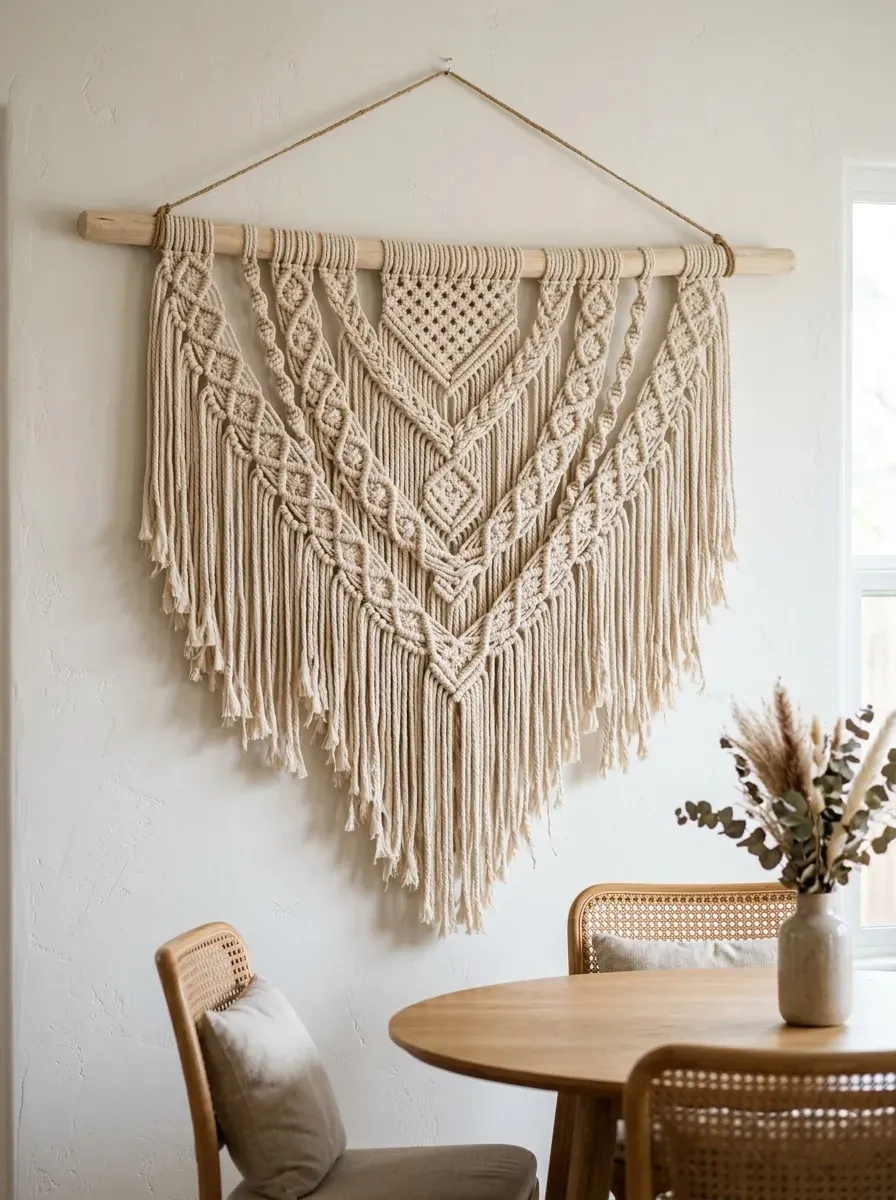
Macramé is back — and it’s easier to make than it looks.
A handmade wall hanging adds warmth and texture to a dining room without competing with other decor. The neutral cotton rope works with almost any color palette. And making one yourself is genuinely satisfying.
You only need two things to start: macramé cord (3mm to 5mm cotton rope works best) and a wooden dowel or a piece of driftwood. Both are available at craft stores or on Amazon for under $20 total.
The most beginner-friendly knot is the square knot. With just this one knot repeated in different patterns, you can create beautiful, complex-looking designs. YouTube has dozens of free tutorials. The Macramé School channel is a great starting point.
Cut your cord about four times longer than your desired finished length. Fold each piece in half, attach it to the dowel with a lark’s head knot, and start knotting.
A simple 18×24 inch hanging can be completed in one afternoon. Add tassels, beads, or dyed sections for extra personality.
Budget tip: A full macramé wall hanging can be made for $15–$25 in materials. Compare that to $80–$200 for a similar piece in a home goods store.
4. Mount a Collection of Vintage Mirrors

Mirrors do something no artwork can: they reflect light and make a room feel larger.
A single large mirror is classic. But a collection of smaller vintage mirrors arranged together? That’s genuinely striking.
The trick is mixing shapes. Combine an ornate oval frame with a simple round one, a sunburst style, and a rectangular beveled mirror. The variety creates visual interest. Keep the finishes in the same family — all gold tones, all silver, or all dark wood — and the collection will feel intentional.
Thrift stores and estate sales are the best places to find vintage mirrors cheaply. You can often find them for $5–$20 each. Don’t skip a mirror just because the frame looks tired — a can of spray paint in gold or matte black transforms a dated frame completely.
Arrangement tip: Lay your mirrors on the floor first to find a grouping you love. The goal is an arrangement that looks balanced without being perfectly symmetrical. Odd numbers (3, 5, or 7 mirrors) tend to look most natural.
Mirrors are especially effective on walls opposite a window. They’ll bounce natural light through the whole room — making your dining room feel brighter even on cloudy days.
5. Install Shiplap or Board-and-Batten Panels

Wood paneling sounds expensive. It doesn’t have to be.
Shiplap and board-and-batten are two of the most popular dining room wall treatments right now — and both are DIY-friendly with basic tools.
Shiplap creates horizontal lines that make a room feel wider. Board-and-batten adds vertical structure that draws the eye up, making ceilings feel higher. Choose based on what your room needs.
For a budget approach, use MDF boards from your local hardware store instead of real wood shiplap. MDF is smooth, easy to paint, and significantly cheaper. A bag of small finishing nails and a nail gun (or even a hammer) is all you need to attach them to the wall.
Paint the panels the same color as the wall for a subtle, textural look. Or go with a bold contrasting color — dark navy or forest green behind a white table is a stunning combination.
Cost breakdown: A 10-foot accent wall in shiplap can cost as little as $80–$150 in materials if you use MDF boards and do it yourself. Professional installation runs $500–$1,500 for the same wall.
There are dozens of free how-to videos online. If you can use a level and a saw (or a friend who can), this is an achievable weekend project.
6. Style a Floating Shelf with Curated Objects
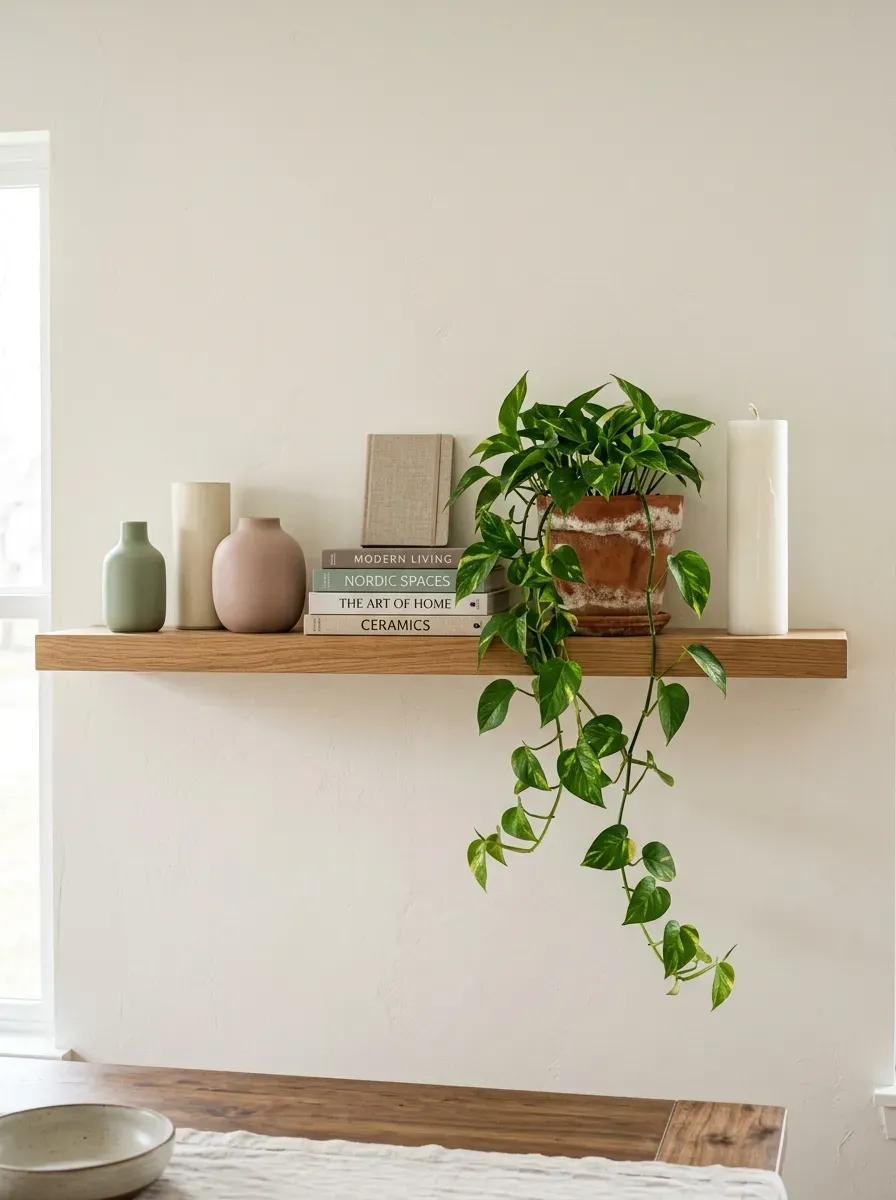
A floating shelf does double duty: it’s functional storage and it’s decor.
The secret to making a shelf look intentional — not cluttered — is in how you style it. Follow the rule of odd numbers. Group objects in threes or fives rather than pairs or fours.
Vary the heights of your objects. Place a tall vase next to a short stack of books next to a small sculpture. This creates a natural visual rhythm that keeps the eye moving.
Add one trailing plant. A pothos or a string of pearls spilling over the edge of a shelf adds life and softens the look of harder objects.
For the shelf itself, you don’t need to spend much. IKEA’s LACK shelves are clean and minimal. For a more rustic feel, a pine board from the hardware store (cut to length) stained in a warm walnut tone looks beautiful and costs around $15–$25.
Style your shelf in layers: start with the largest object, add medium pieces, fill gaps with small items, and finish with a plant or trailing greenery.
Swap items seasonally to keep the shelf feeling fresh. Holiday-specific objects can be swapped in and out easily — and it gives your dining room a new look a few times a year without spending much.
7. Hang Woven Rattan or Seagrass Panels

Woven wall panels bring an organic, natural texture that’s hard to replicate with any other material.
Rattan, seagrass, and jute panels add warmth without adding color — making them perfect for dining rooms that already have a strong palette. They work beautifully in coastal, bohemian, and Scandinavian-inspired spaces.
Large panels (think 24×36 inches or bigger) make the most impact. Hang two side by side for a symmetrical look. Or hang three panels in a staggered arrangement for something more casual and relaxed.
You can find woven wall panels on Amazon, World Market, and Target for $30–$80 each. For a DIY version, look for rattan placemats at discount stores — they can be grouped together, attached to a backing board, and hung as a custom panel for a fraction of the cost.
Styling tip: Pair woven panels with warm wood tones, linen textiles, and terracotta ceramics. This creates a layered, organic aesthetic that feels collected over time rather than purchased all at once.
These panels also have a practical bonus: they absorb sound. Dining rooms can echo when filled with hard surfaces like tiles and glass. A few woven panels on the walls noticeably reduce noise during dinner parties.
8. Try a Mural or Wallpaper Accent Wall
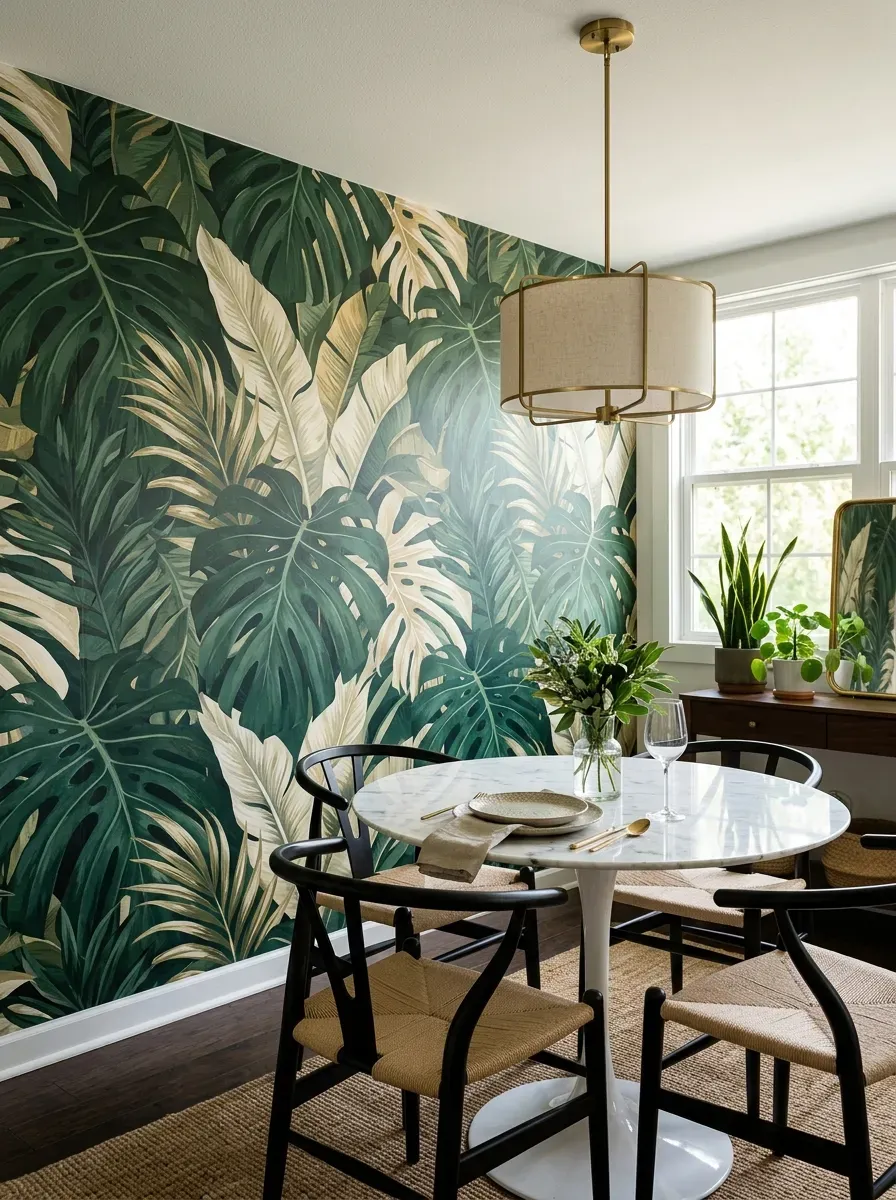
Wallpaper used to mean a full-room commitment. Not anymore.
An accent wall in a single bold print or mural-style design can completely transform a dining room — and with peel-and-stick wallpaper, it’s fully reversible.
Botanical and jungle prints are the most popular right now. Think oversized palm leaves, tropical flowers, or abstract watercolor patterns. These prints make a small dining room feel like a lush, immersive space.
Peel-and-stick options have improved dramatically in quality. Brands like Chasing Paper, Tempaper, and Walls Need Love make designs that look indistinguishable from traditional wallpaper. Prices range from $25–$60 per roll, and most accent walls require 2–4 rolls depending on size.
Installation is straightforward. Clean the wall thoroughly, cut panels to size, and smooth from top to bottom using a credit card to remove bubbles. No paste, no mess. Most people complete an accent wall in 2–3 hours.
If wallpaper feels like too much, consider a painted mural instead. Simple abstract shapes, arches, or a two-tone color block are achievable even for non-artists. Use painter’s tape to create clean edges and a foam roller for smooth coverage.
9. Display a Woven Tapestry
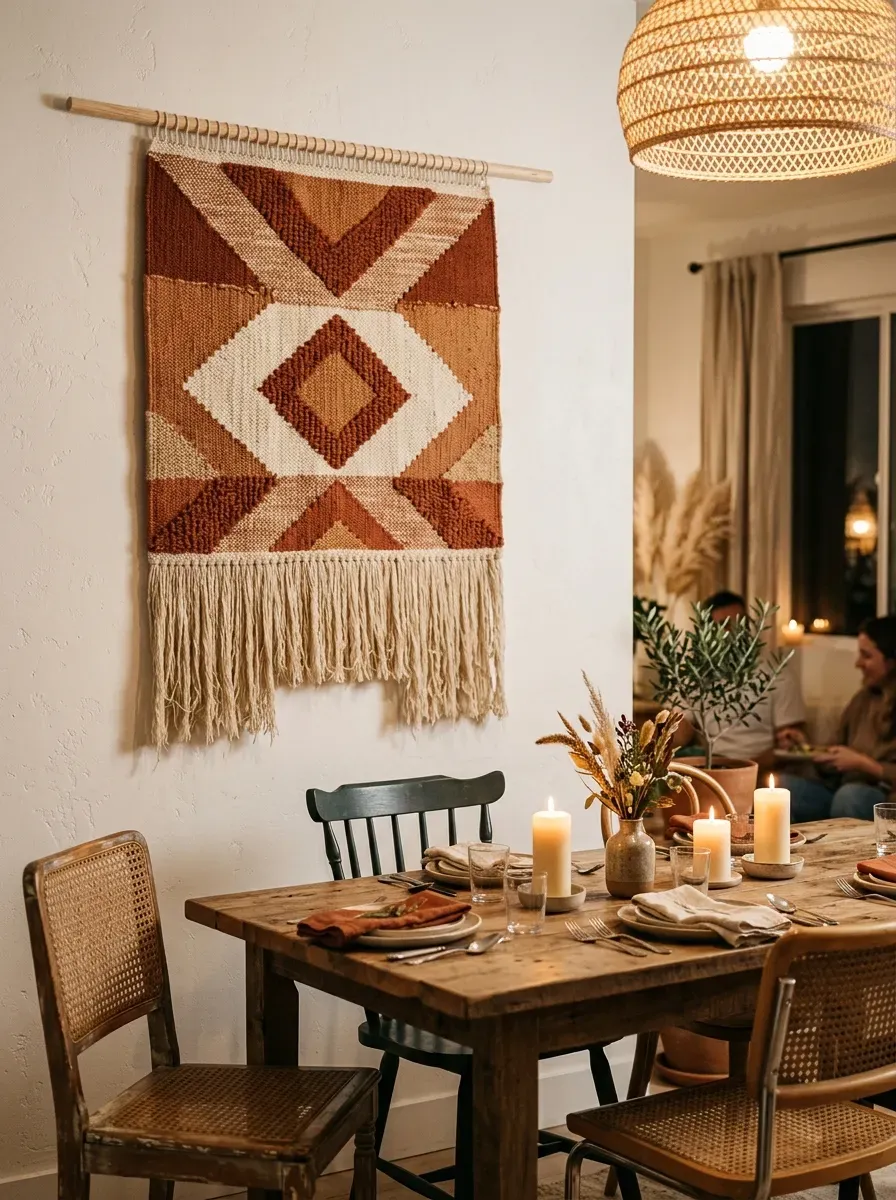
A tapestry is one of the most forgiving wall decor options you can choose.
It covers a large area quickly. It adds color and texture at the same time. And because it’s fabric, it softens the acoustics of a hard-surfaced room.
Look for tapestries with geometric patterns or abstract designs — these tend to age well and don’t feel as trend-dependent as figurative prints. Earth tones (rust, cream, terracotta, olive) work in almost any dining room palette.
Hang a tapestry from a thin wooden dowel with a few simple screws and nails. Many tapestries come with a rod pocket sewn in, making hanging even simpler.
Where to find them affordably:
- Etsy sellers offer handmade tapestries from $40–$120
- Amazon and World Market carry machine-woven versions for $25–$60
- Thrift stores occasionally have vintage tapestries for under $20
If you want to make one yourself, a simple woven wall hanging on a small loom is achievable as a beginner. Loop Yarn Market has beginner kits for around $35.
Scale matters. A tapestry for a dining room should be at least 36 inches wide to feel intentional. A small tapestry on a large wall looks like an afterthought.
10. Hang Oversized Abstract Art
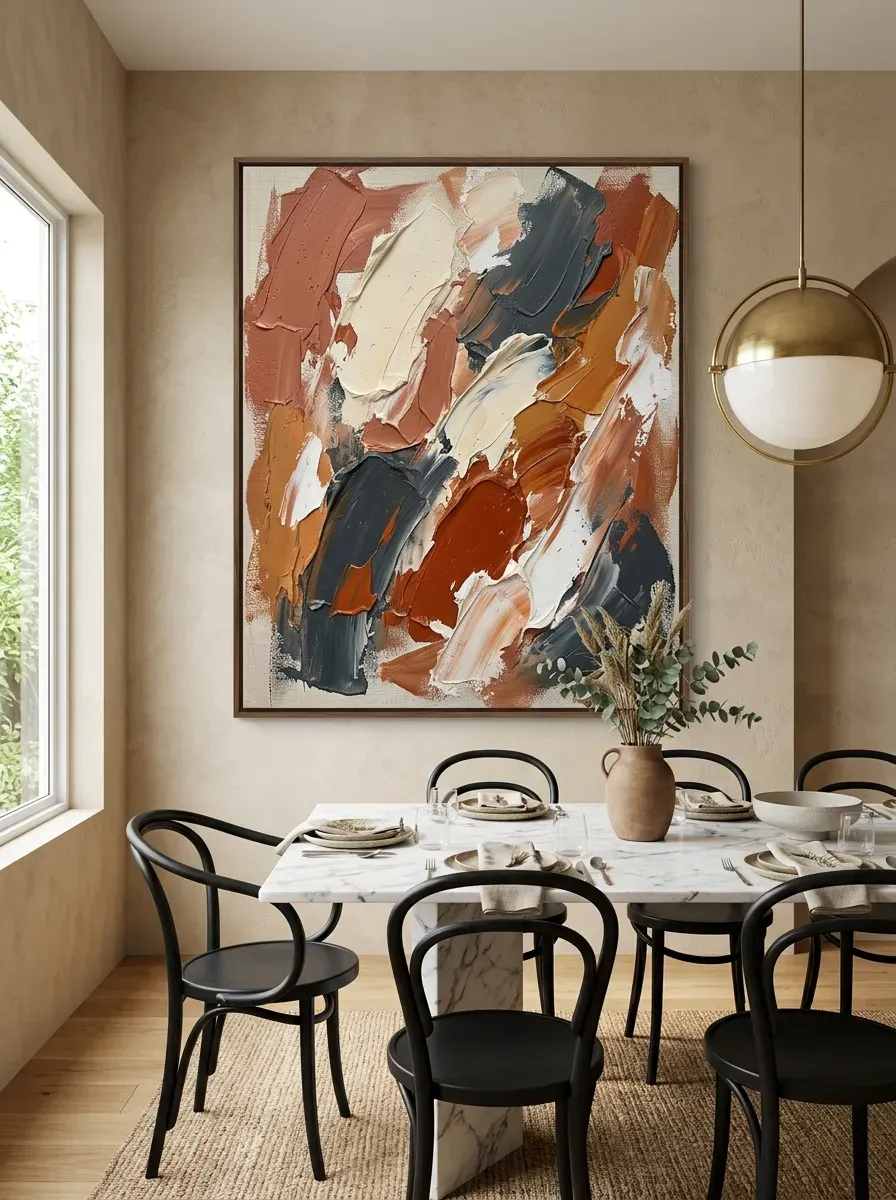
Abstract art works where realistic or figurative art sometimes struggles — it doesn’t compete with the room, it complements it.
A single oversized abstract canvas (40×50 inches or larger) becomes the anchor of your entire dining room. Everything else in the room — your furniture, textiles, lighting — can be organized around it.
The good news: you don’t need to spend thousands of dollars on original abstract art.
Option 1: Make your own. Large canvases from craft stores cost $20–$40. Acrylic paint in 3–5 colors from a hardware store costs under $20. Apply paint loosely with a palette knife or a credit card for an organic, layered look. Abstract painting is forgiving — there’s no “wrong.”
Option 2: Buy a print. Sites like Society6, Minted, and Desenio offer large abstract prints at reasonable prices. A 24×36 print typically runs $30–$70.
Option 3: Use printable art. Download a high-resolution abstract file on Etsy ($5–$15) and print it at a local print shop at whatever size you need.
When choosing colors for abstract art, pick from tones already present in your room. If your rug has navy and ochre, look for abstract art in similar tones. This creates a coherent, collected feel.
11. Create a Plate Wall Display
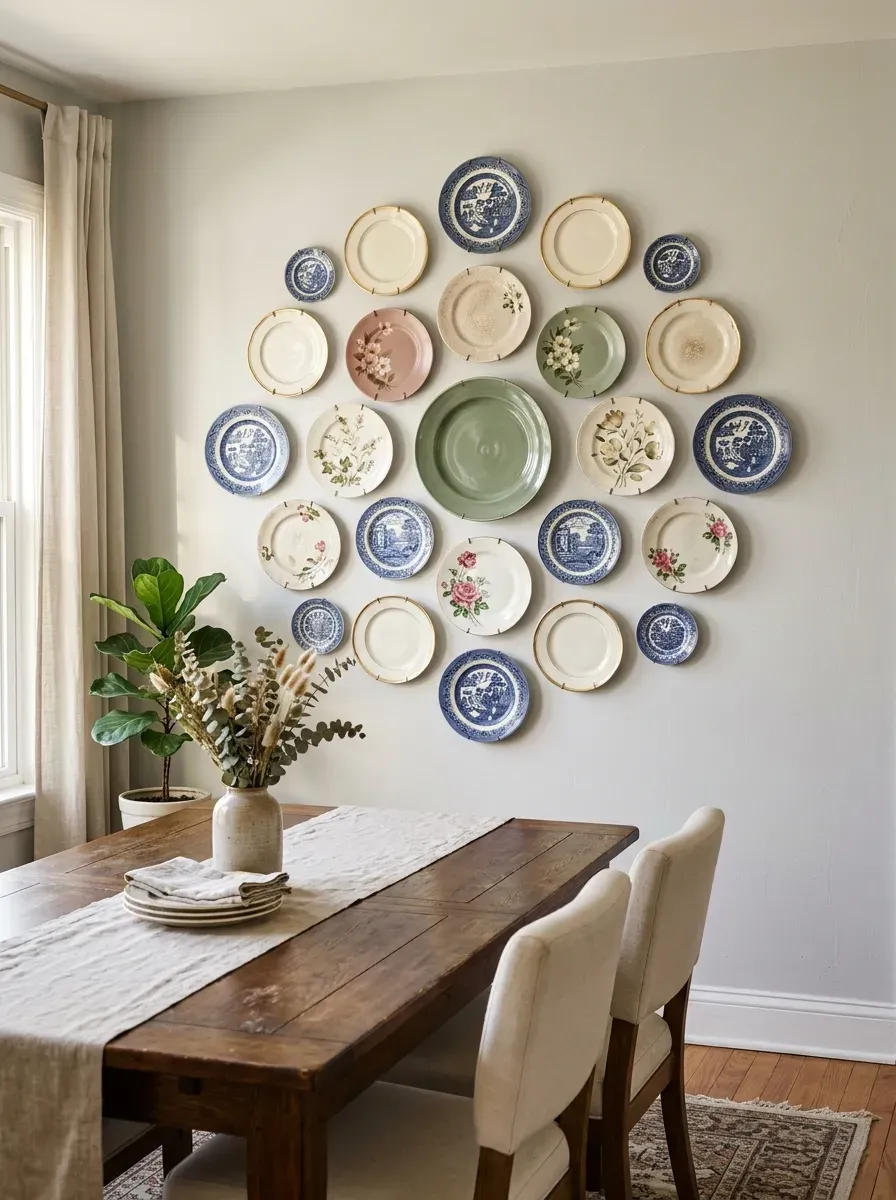
Plate walls are a centuries-old decorating tradition — and they’re having a serious comeback.
The appeal is simple. Decorative plates are widely available, inexpensive, and come in an incredible variety of styles. You can build a plate wall that looks completely different depending on what you choose: rustic farmhouse, maximalist grandmillennial, coastal blue-and-white, or modern minimal.
Thrift stores and estate sales are the best sources. You can often find beautiful individual plates for $1–$5 each. Don’t worry about matching — a cohesive plate wall works best when pieces share a color family but vary in pattern and size.
Plate hangers are the key tool. These small spring-wire devices hook onto the back rim of a plate and provide a keyhole for hanging. They’re available at hardware stores and on Amazon for around $1 per hanger.
Plan your arrangement on the floor before hanging. Take a photo. Then trace the plate positions on paper, tape to the wall, and nail through the paper as a guide.
Style tips:
- Group plates tightly — large gaps between them look awkward
- Mix sizes: large plates at center, smaller ones around the edges
- Add a small framed print or a decorative object to break the grid
12. Use Dried Botanicals as Wall Art
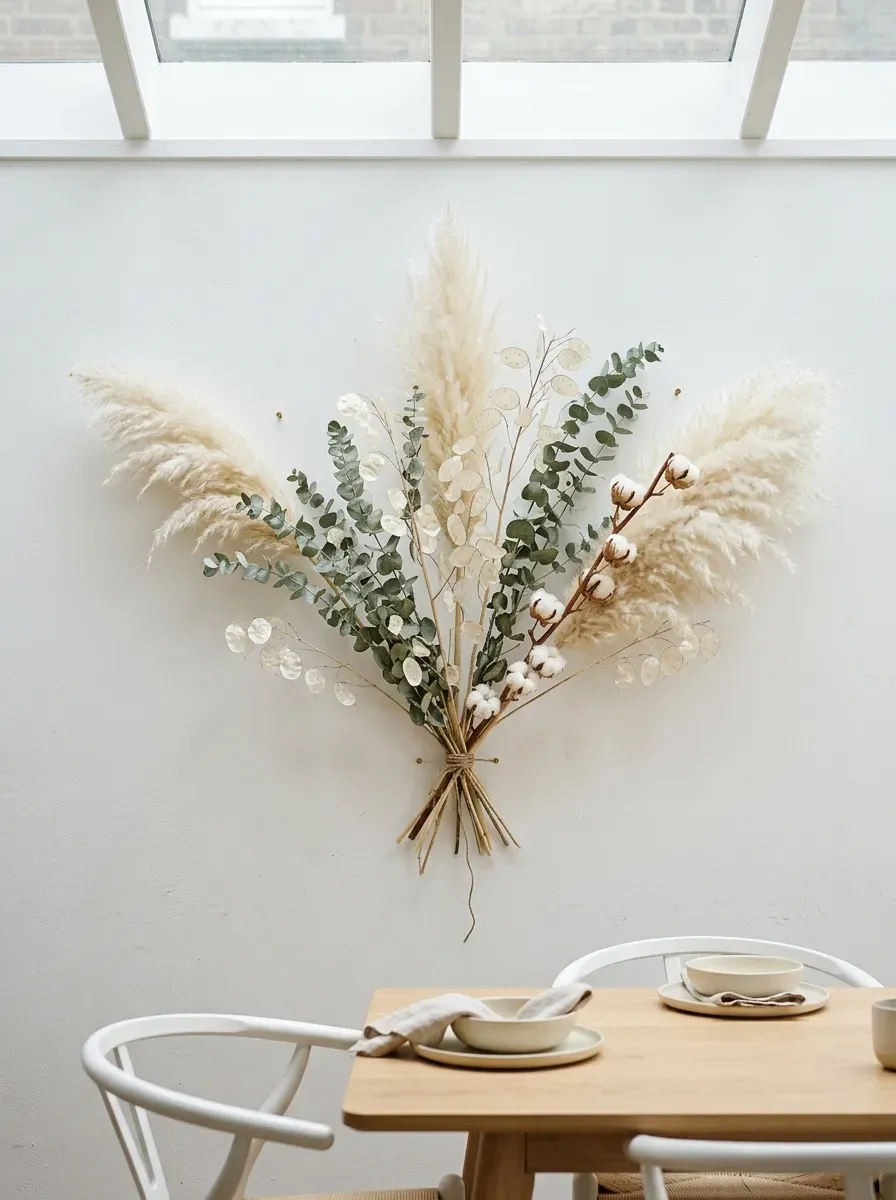
Fresh flowers die. Dried botanicals last for years.
A large arrangement of dried grasses, preserved florals, and seedpods pinned directly to the wall creates something that looks effortlessly artistic — even if you’ve never arranged flowers in your life.
The best materials for a dried wall arrangement:
- Pampas grass (feathery, statement-making, lasts indefinitely)
- Dried lunaria (silver dollar plant — translucent and ethereal)
- Dried eucalyptus (holds its color beautifully)
- Dried lavender (adds subtle scent for months)
- Cotton stems (soft, sculptural, long-lasting)
You can source these at craft stores, Trader Joe’s floral section, or online on Etsy. A full arrangement of materials typically costs $20–$50.
No frame or vase needed. Simply gather stems in a loose bouquet shape, bind the base with floral wire or twine, and nail directly to the wall through the binding.
Let the arrangement fan out naturally — resist the urge to over-style it. The organic looseness is part of the charm.
Maintenance is minimal. Occasionally dust with a hair dryer on cool setting. Most dried arrangements look beautiful for 2–3 years before fading.
13. Install Picture Ledges for Easy Swapping
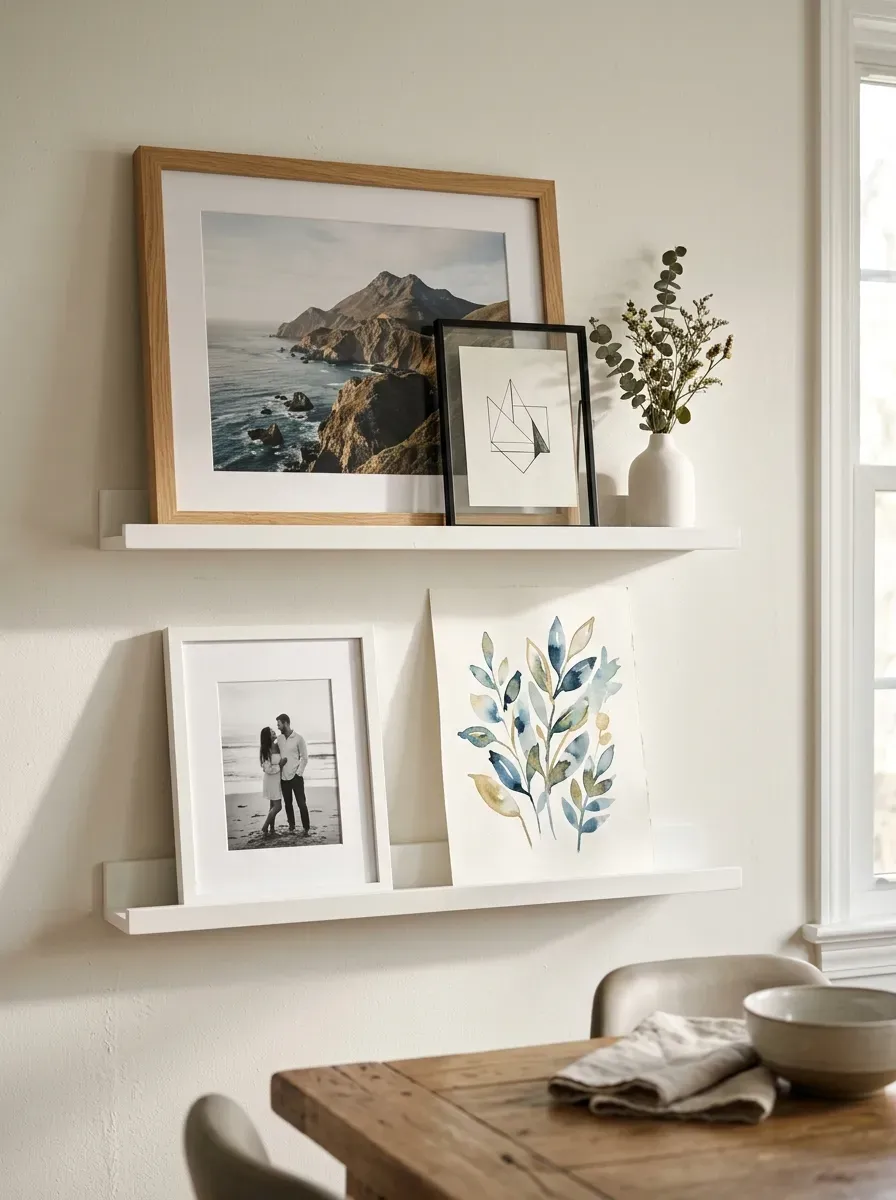
Picture ledges are the most flexible wall display system available.
Unlike traditional gallery walls where art is hung with nails, ledges let you lean artwork against the wall. That means you can swap pieces in and out anytime without patching holes or repainting.
IKEA’s MOSSLANDA picture ledge is the most popular choice. At around $12–$15 per ledge, it’s incredibly affordable. Each ledge holds multiple frames of varying sizes.
Install 1–3 ledges at different heights. Stagger them slightly for visual interest. Then layer your frames: large prints in the back, smaller ones leaning in front. Add small ceramic pieces or sculptures between frames for depth.
The magic of ledges is that they make your wall feel like an evolving gallery rather than a fixed decoration. Rotate pieces with the seasons. Add new finds from thrift stores. Move things around when you want a change.
This approach works especially well for people who love art but can’t commit to a permanent arrangement — or anyone renting and wanting to minimize nail holes.
What to display on ledges:
- Framed prints and photos
- Small mirrors
- Unframed canvases
- Postcards and cards tucked into frames
- Small sculptural objects
14. Hang a Pegboard for Functional Wall Decor
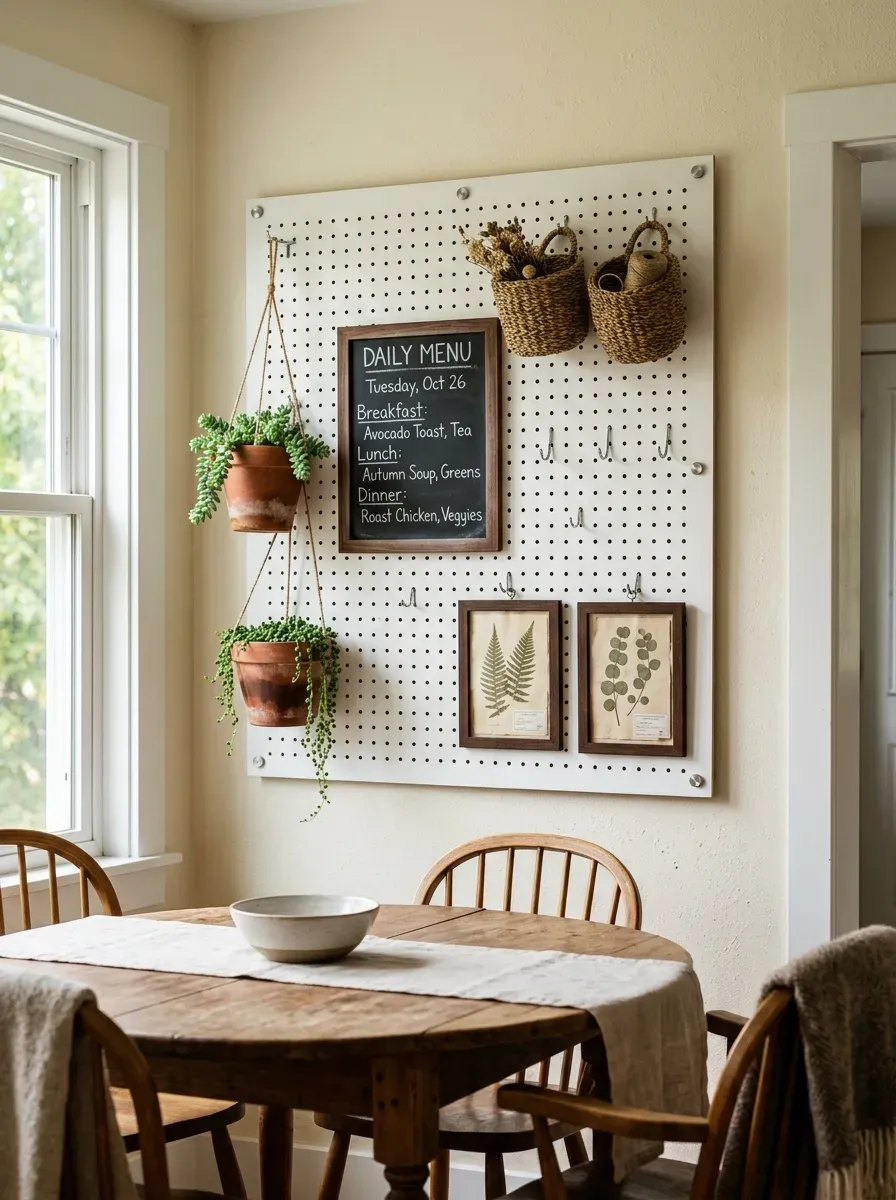
Pegboard isn’t just for garages and craft rooms anymore.
Painted in the right color and styled intentionally, a pegboard panel in a dining room is both functional and visually interesting. It’s especially useful in smaller spaces where wall real estate serves double duty.
Use your dining room pegboard to display:
- Small potted plants in hanging baskets
- A hand-lettered menu board
- Hooks for aprons or a spare table runner
- Small framed art or pressed botanicals
- Kitchen tools if your dining room is adjacent to an open kitchen
To install: Purchase a pegboard panel at any hardware store (around $10–$20 for a 2×4 foot panel). Paint it to match your wall for a subtle look, or go bold with a contrasting color for impact. Mount it with standoff screws to leave a small gap between the board and the wall — this allows hooks to seat properly.
The hooks themselves are inexpensive — around $5–$10 for a pack of assorted sizes.
Style tip: Don’t cover every hole. Leave intentional empty space to prevent the board from feeling chaotic. Arrange objects asymmetrically, with heavier visual elements on one side and trailing elements (like hanging plants) on the other.
15. Frame Vintage Maps or Travel Memorabilia
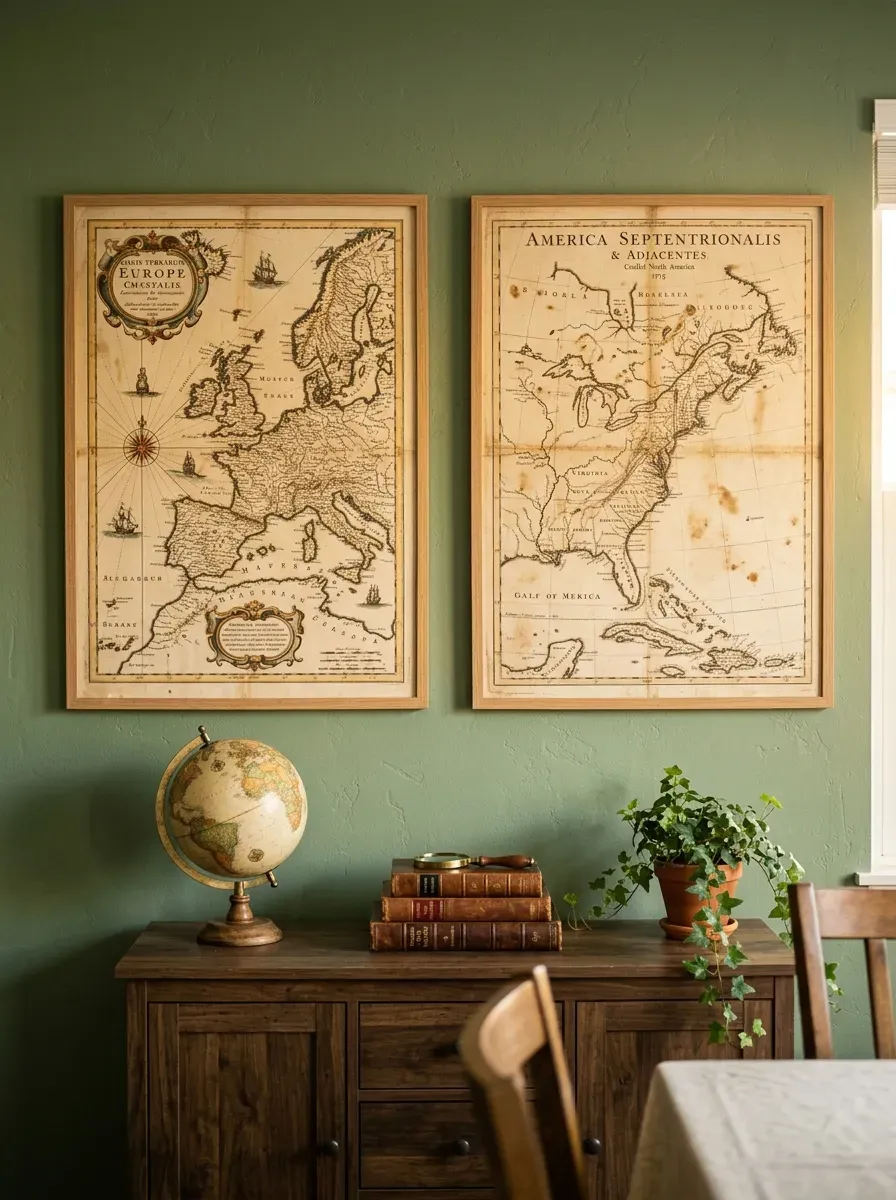
If your dining room doubles as a gathering space for conversation and dinner parties, maps are a natural fit.
Vintage maps are beautiful objects. The aged colors, intricate linework, and the sense of history they carry make them visually rich in a way that most modern prints can’t match.
Where to find them:
- Estate sales and antique markets (often $5–$30 for genuine vintage maps)
- Etsy (printable vintage map files for under $10 — then print at any copy shop)
- Old atlases from thrift stores (individual pages can be framed beautifully)
- National Geographic has an archive of stunning historical maps available for purchase
Frame them simply — a thin black or wood frame with a wide white mat makes even an inexpensive print look elegant.
Style idea: Create a “travel wall” that tells the story of places that matter to you. A map of where you grew up, where you met your partner, where you honeymooned. This kind of personal curation makes a wall feel meaningful rather than decorative.
Practical tip: Oversized maps (24×36 or larger) work best in dining rooms. A small map on a large wall looks lost. Go big, or pair two or three smaller maps in a symmetrical arrangement.
16. Add a Chalkboard or Magnetic Paint Wall
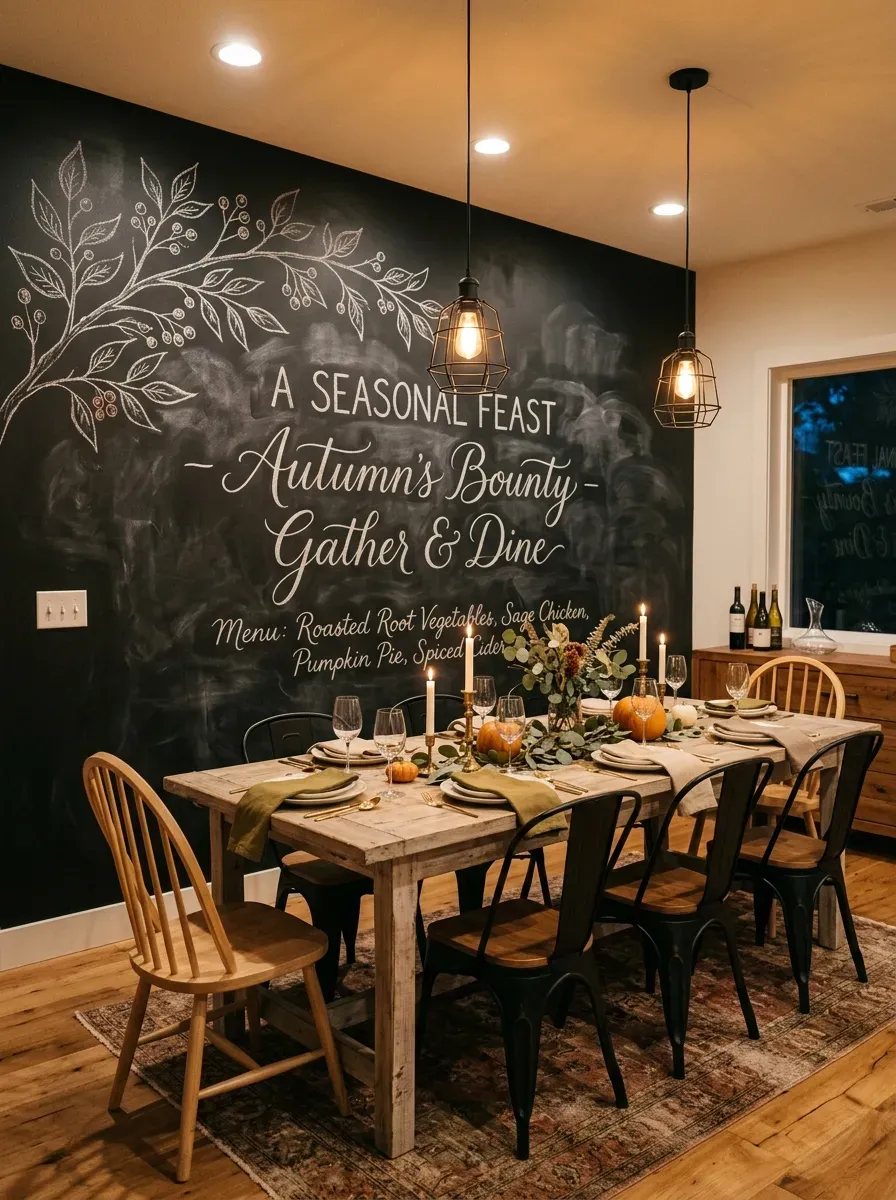
A chalkboard wall turns your dining room into a living, ever-changing piece of art.
Paint one wall (or a portion of a wall) with chalkboard paint and suddenly you have a surface for seasonal menus, kids’ drawings, guest messages, inspirational quotes, or abstract chalk art.
Chalkboard paint is available at most hardware stores for around $15–$25 per quart — enough for a 6×8 foot section of wall. Apply 2–3 coats for full, even coverage. Once dry, “season” the surface by rubbing the side of a piece of chalk over the entire area and then erasing — this prevents ghosting when you write.
Ideas for what to put on a chalkboard dining room wall:
- A hand-lettered seasonal menu
- A world map traced in chalk
- A family quote or memory from a dinner conversation
- An abstract botanical illustration
- A countdown to a holiday or celebration
The key to making a chalkboard wall look intentional rather than juvenile is scale and lettering quality. Large, confident lettering in simple fonts looks beautiful. Cramped or timid writing looks like a school project.
If chalkboard feels too casual, magnetic paint (applied first, then topped with your wall color) lets you hang artwork and notes with magnets without drilling a single nail.
17. Cluster Small Art Prints in Matching Frames
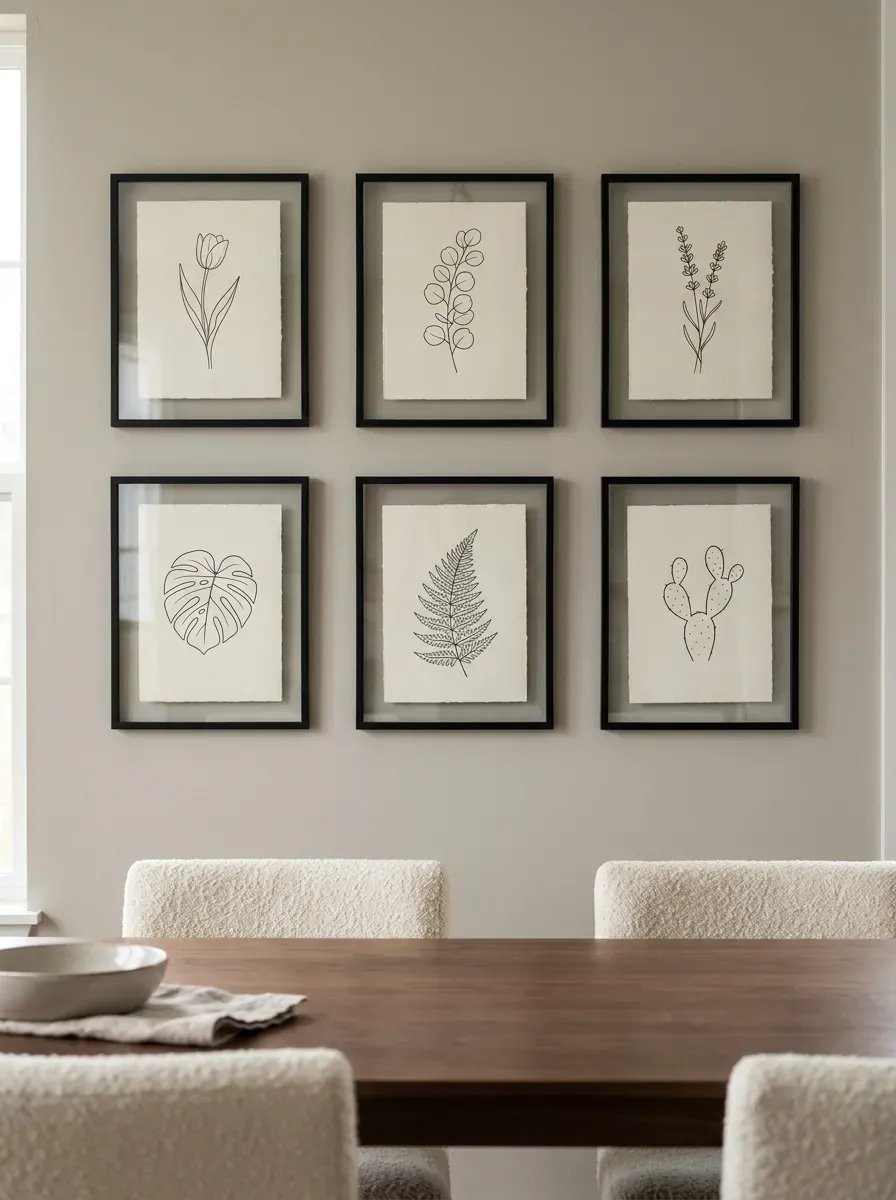
Sometimes the most powerful wall arrangement is one with strict constraints.
Choose one frame style — say, thin black metal — and buy six identical frames in the same size (5×7 or 8×10). Then fill them with art that shares a visual theme: all botanical line drawings, all black-and-white photos, all abstract color studies.
The uniformity of the frames makes the arrangement feel designed rather than random. Even if the content varies, the identical frames create order.
Arrangement options:
- Two rows of three (classic grid)
- A horizontal line of six in a row
- A loose cluster with irregular spacing
Grid arrangements feel modern and minimal. Clustered arrangements feel more collected and organic. Choose based on your overall dining room style.
Budget breakdown: IKEA and Amazon both sell packs of black metal frames for around $5–$10 each. Six frames will run you $30–$60 total. Art prints from Etsy, Desenio, or Society6 in smaller sizes run $5–$15 each. A full six-print arrangement with frames can cost under $100.
For an even more affordable approach, print your own art. Search for “free printable art” — there are hundreds of high-quality botanical, abstract, and typography prints available for free download.
18. Hang a Wicker or Rattan Sunburst Mirror
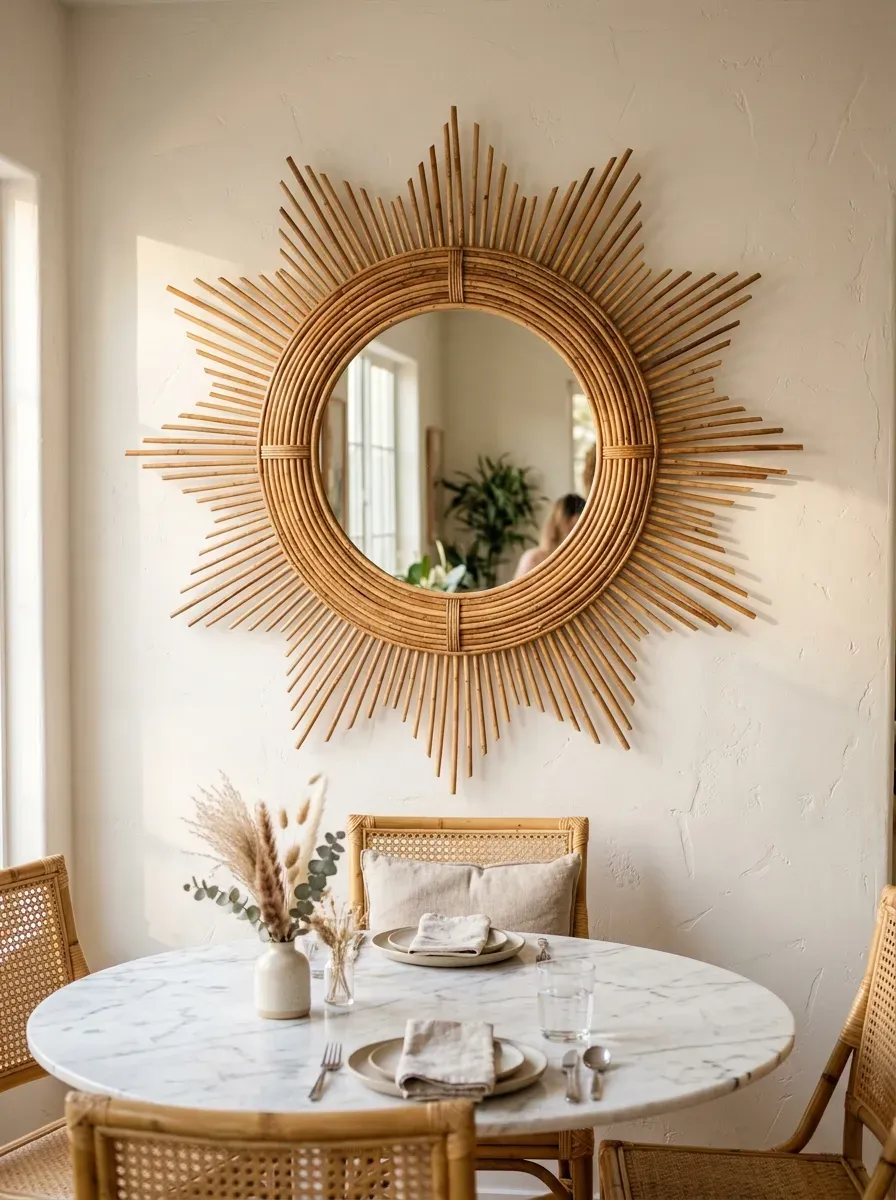
A sunburst mirror is one of the most impactful single pieces you can hang in a dining room.
It reflects light. It creates a focal point. It works as a piece of art even when no one is looking at their reflection. And the rattan or wicker version adds organic texture that softens modern spaces and enriches bohemian or coastal ones.
Sunburst mirrors range wildly in price — from $30 at Target or HomeGoods to $300+ at specialty retailers. The good news is that the affordable versions often look just as beautiful in context.
Placement tip: Hang a sunburst mirror centered above a sideboard or buffet table, or centered on a blank wall opposite a window. The reflected light will do the work.
If you’re ambitious, a DIY sunburst mirror is achievable. Start with a simple round mirror (even from a dollar store). Hot glue wooden skewers, chopsticks, or thin bamboo rods around the edge in an alternating pattern. Spray paint the whole thing in gold or matte black. It takes about two hours and costs under $20.
Scale considerations: A sunburst mirror should be at least 24 inches in diameter to read well in a dining room. Smaller versions get lost on large walls.
19. Create a Photo Timeline Wall
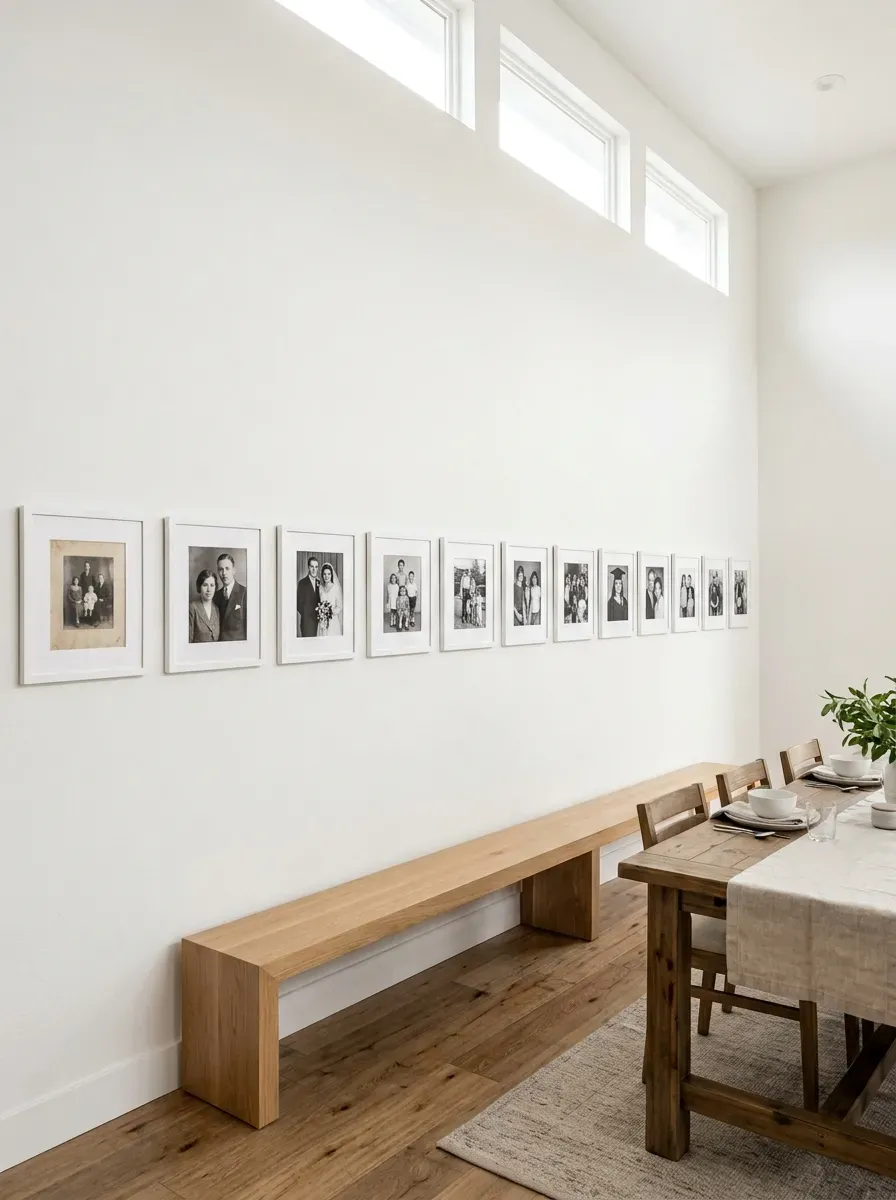
A photo wall that tells a story is more interesting than one that simply looks pretty.
Instead of arranging photos randomly, create a visual timeline — a chronological sequence of images that traces a family history, a relationship, or a personal journey. Start from the left and move right.
This kind of arrangement gives dinner guests something to look at and talk about. It’s inherently personal. And it gets more interesting every year as you add new photos.
How to build it:
- Choose a consistent frame style — all white, all black, or all natural wood
- Print photos in one consistent size (4×6 or 5×7 works well for a long timeline)
- Start with your oldest image on the far left
- Space frames evenly — use a measuring tape and pencil to mark center points before hanging
- Hang all frames so their center points align at the same height
Photo printing is cheap. Walmart, Walgreens, and Costco all offer photo prints for under $1 each. For a 20-photo timeline wall, your entire photo cost might be $15–$20.
Add a small handwritten or printed date label below each frame for an archive-style look. Or keep it clean and label-free — let the images speak.
20. Install Vertical Wood Slat Panels
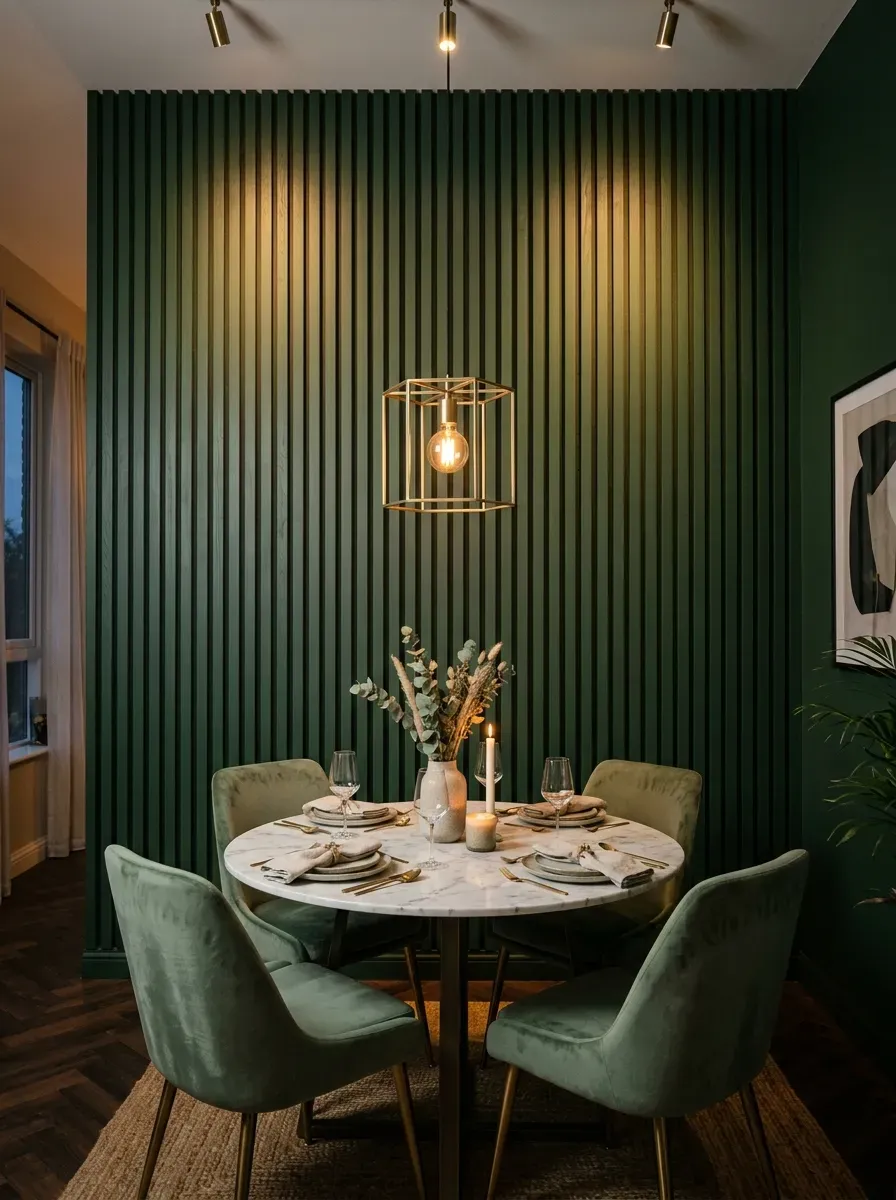
Vertical wood slat panels are the architectural wall treatment of the moment — and for good reason.
They add depth and dimension to a flat wall without overwhelming it. The vertical lines draw the eye up, making ceilings feel higher. And depending on the paint color, they can feel industrial, Scandinavian, earthy, or modern.
The panels themselves can be made from thin pine boards (1×2 or 1×3 from the hardware store), spaced at regular intervals and nailed to a backing board or directly into studs.
Color choices transform the effect entirely:
- Natural wood tones feel warm and organic
- White or cream feels clean and Scandinavian
- Deep navy or forest green feels dramatic and modern
- Black creates a bold, gallery-like backdrop
Materials cost: Pine 1×2 boards run about $2–$4 per 8-foot board. For a standard 10-foot wide wall, you’ll need approximately 15–20 boards, depending on spacing. Total material cost: $40–$80.
This is a weekend project for a moderately confident DIYer. Renting a nail gun from a hardware store ($20–$30 for the day) makes the installation significantly faster and cleaner than using a hammer.
21. Display a Textile or Quilt as Wall Art
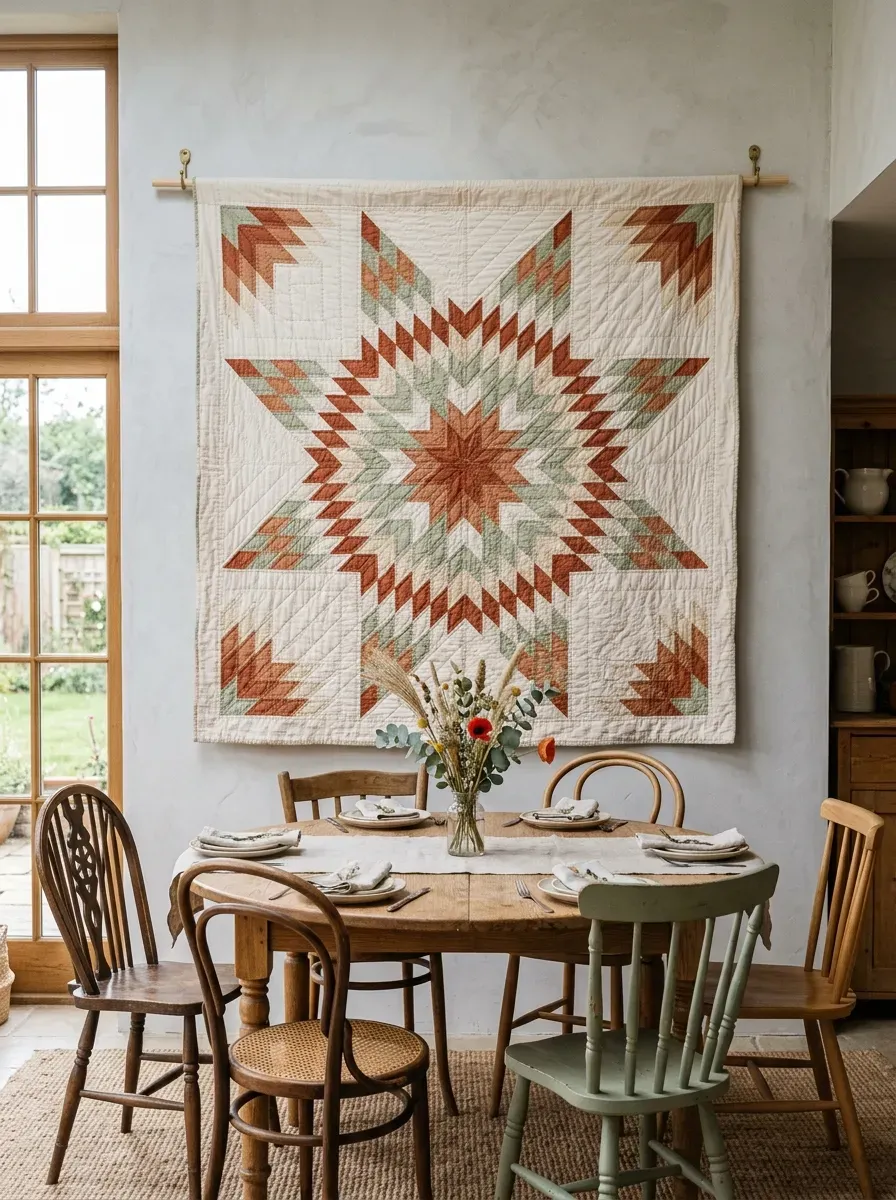
Quilts and woven textiles are underrated as wall art.
A single large quilt hung on a dining room wall adds color, pattern, and warmth all at once. It’s especially effective in farmhouse, cottage, or eclectic spaces where layered textiles feel at home.
Old quilts from thrift stores or estate sales are often beautiful — and extremely cheap. A worn quilt with visible character can cost as little as $5–$20. The imperfections (a faded patch, a repaired section) add to the charm rather than detracting from it.
How to hang a quilt:
- Sew or pin a rod pocket along the top edge
- Slide a thin wooden dowel through the pocket
- Hang the dowel from two small hooks mounted in the wall
This method distributes the weight evenly and avoids damaging the fabric.
Alternatively, use quilt hanging clips or special quilt hangers designed for the purpose — available at craft stores for under $15.
If you have a family heirloom quilt stored in a closet, this is a beautiful way to display it. It protects the quilt from being folded and refolded (which damages fabric over time) while turning a treasured object into daily decor.
New handmade quilts from Etsy artists run $80–$250 depending on size and complexity — still far less than comparable textile wall art from home decor stores.
22. Try a Two-Tone Color Block Wall
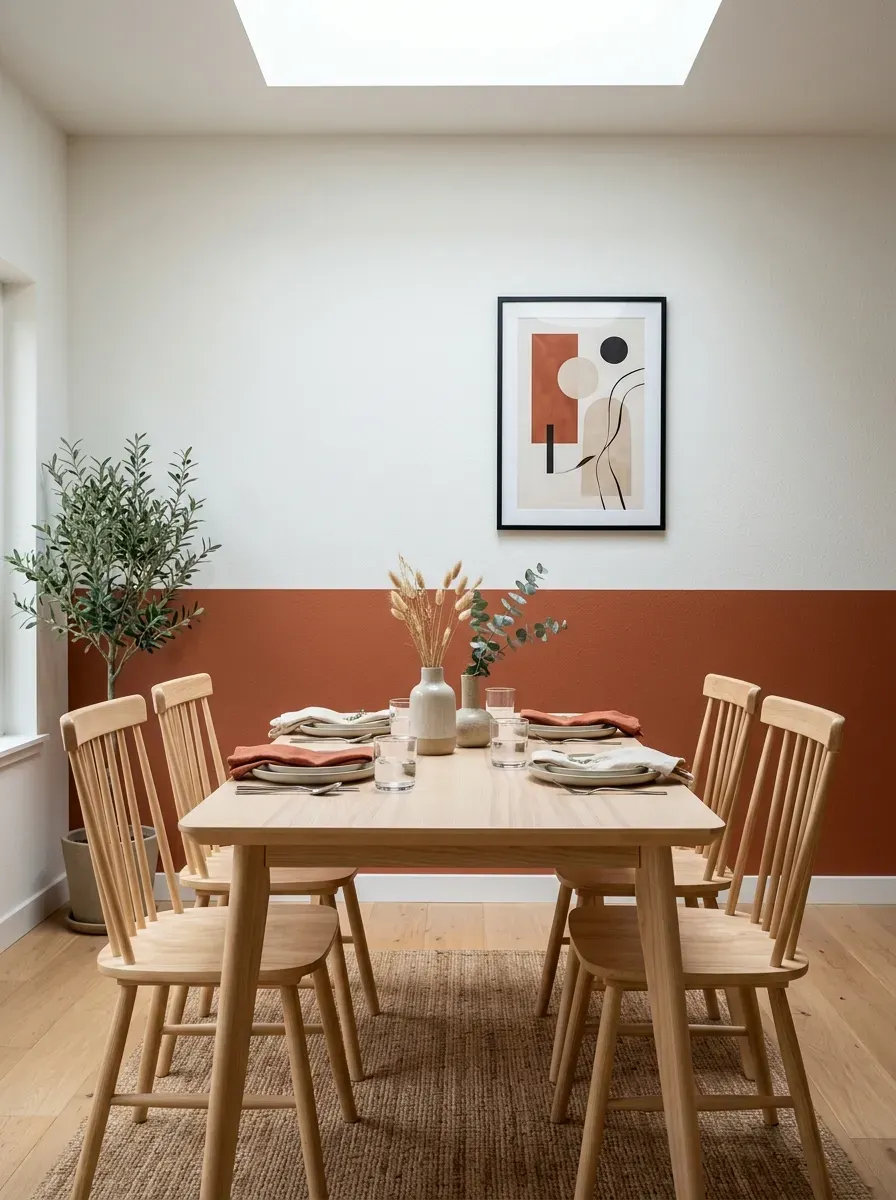
A color block wall requires no art, no frames, no decorative objects — just two cans of paint and a roll of painter’s tape.
The idea is simple: paint the lower portion of your wall one color and the upper portion another. The dividing line is typically at chair rail height (about 32–36 inches from the floor) but can go anywhere from one-third to two-thirds of the way up.
The most popular combinations:
- Deep terracotta bottom, warm white top
- Forest green bottom, cream top
- Navy bottom, pale blush top
- Black bottom, light gray top
This approach works in almost any space. It adds visual interest to a plain wall without requiring a full commitment to a bold color throughout the entire room.
Total cost: Two quarts of paint ($15–$20 each), one roll of painter’s tape ($5–$10), a roller and tray ($10–$15). Total: under $60 for a dramatic wall transformation.
Pro tip: After applying your painter’s tape, run a thin bead of the lighter color over the tape edge first. Let it dry, then apply your main darker color. This technique seals the tape edge and prevents bleed-through for perfectly crisp lines.
A color block wall pairs beautifully with a single framed print hung on the upper section.
23. Mount Sculptural Wall Objects
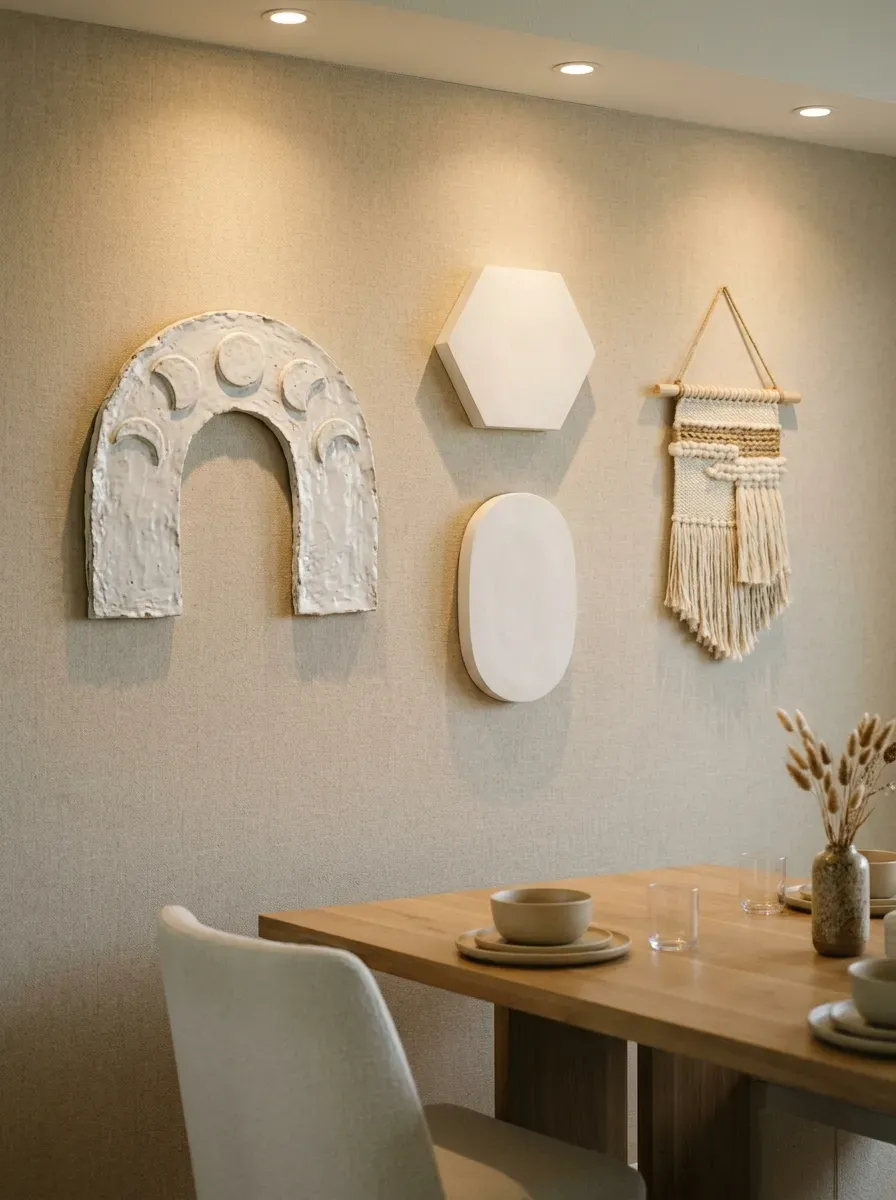
Flat art has its limits. Sculptural wall objects add something flat art can’t: actual shadow and depth.
As light moves through the day, sculptural objects cast changing shadows on the wall behind them. The visual effect shifts from morning to afternoon to evening. It’s subtle, but it makes the wall feel alive.
Popular sculptural wall decor options:
- Ceramic wall hangings (moon shapes, organic forms, geometric tiles)
- Woven fiber art pieces in 3D forms
- Metal wall sculptures (abstract, botanical, geometric)
- Plaster or clay forms mounted directly to the wall
- Wooden wall objects (carved panels, sculptural shelves)
Mix a few different textures together. A ceramic piece next to a woven object next to a metal element creates a rich, layered arrangement.
Budget-friendly sources: HomeGoods and TJ Maxx regularly carry sculptural wall art at significant discounts. Amazon and Etsy have extensive selections. For the most affordable approach, look for unfinished wooden wall cutouts at craft stores and paint them yourself.
DIY option: Air-dry clay is inexpensive ($10–$15 per package) and can be shaped into simple wall plaques, pressed with leaf textures, and painted once dry. These handmade pieces often look more beautiful than store-bought alternatives.
24. Hang Framed Fabric or Wallpaper Swatches
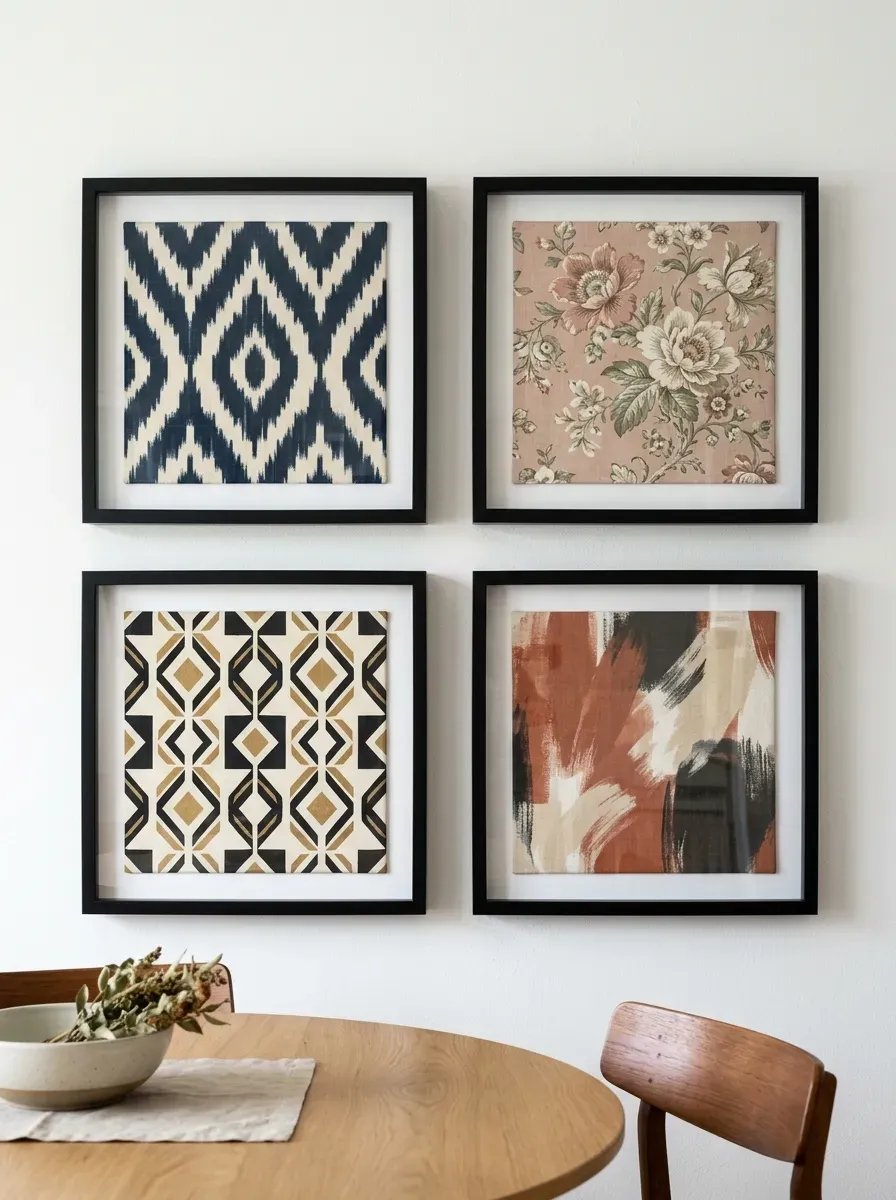
Here’s a little-known secret: framed fabric and wallpaper swatches look indistinguishable from custom textile art.
Fabric stores, wallpaper showrooms, and online shops often sell remnants, sample books, and discontinued swatches at dramatically reduced prices. A beautiful fabric panel in a standard 8×10 or 11×14 frame becomes a piece of art for $5–$20 total.
What to look for:
- Ikat, block print, or geometric fabric panels
- Vintage or discontinued wallpaper samples
- Upholstery fabric with interesting texture or pattern
- Sari fabric or printed cotton from international textile shops
Simply cut the fabric or wallpaper to fit the frame, attach it to a piece of cardstock or foam board as a backing, and frame it like any other art.
This approach is especially useful for pulling color from your dining room textiles into your wall art. If your dining chairs are upholstered in a particular fabric, frame a remnant of that same fabric. It ties the room together in a way that feels intentional and designed.
Arrange 4–6 framed swatches in matching frames for a curated textile art installation. Keep the frames identical for a modern, editorial feel.
25. Use a Living Wall or Mounted Planter System
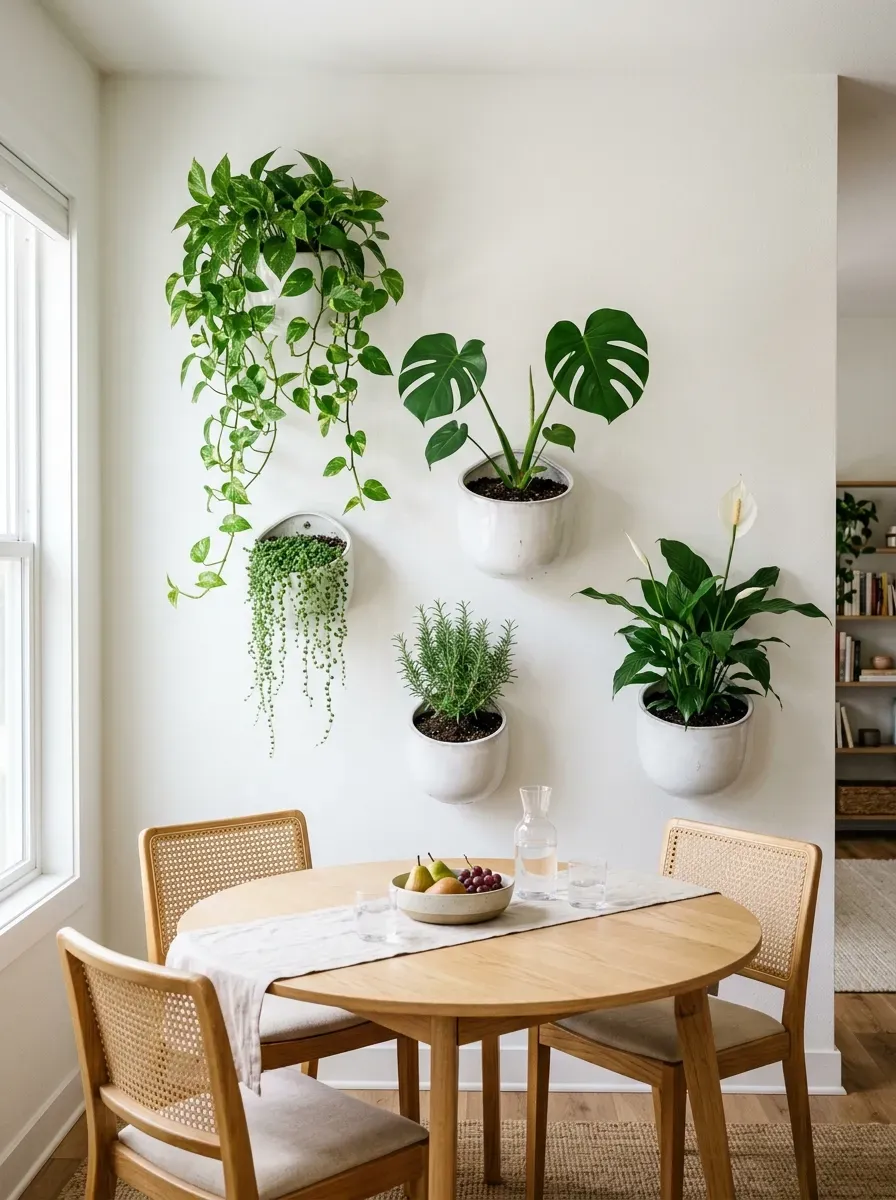
The only thing better than art on your walls is living plants on your walls.
A mounted planter system brings the one thing no print or textile can offer: something alive and growing. Plants clean the air, add humidity, and create a visual connection to the natural world that’s genuinely calming.
Wall-mounted planters range from simple single hooks to elaborate modular systems. For a dining room, a simple arrangement of 4–8 individual wall planters in a staggered pattern is typically the most beautiful approach.
Best plants for a dining room wall:
- Pothos (nearly indestructible, trails beautifully)
- String of pearls (delicate and architectural)
- Trailing philodendron (fast-growing, lush)
- Small monstera or split-leaf philodendron (bold, tropical)
- Herbs (basil, thyme, rosemary — if near a window)
Wall planters are available from IKEA (BITTERGURKA or SKURAR), Amazon, and Target for $5–$20 each.
Practical consideration: Make sure your wall gets adequate indirect light. Most trailing houseplants tolerate low light well. If your dining room is dark, choose low-light varieties like pothos or ZZ plants.
Water carefully — allow soil to dry between waterings to protect your wall from moisture damage.
Conclusion
Your dining room walls don’t have to be an afterthought. They can be the most personal, most visually interesting part of your home.
The 25 ideas here run the full range — from a $10 DIY macramé knot to a weekend board-and-batten project to a single large botanical print that does all the heavy lifting on its own. There’s no single “right” approach. The right approach is the one that fits your style, your space, and your budget.
Start small if you’re unsure. Hang one large print. Style one floating shelf. Add a single sculptural wall object. Live with it for a week and see how it changes the feel of the room.
You’ll quickly realize what most experienced decorators already know: the walls are where the personality of a room lives. Fill yours with things that mean something. The rest will follow.
Pick one idea from this list today. Your dining room is ready for it.
